Hot new social network Moltbook exposed 1+ million credentials

Chinese state actors were likely behind Notepad++ hijacking, Bill to allow the Russian government to shut down comms networks moves forward, ICE uses app that accesses 1.2B facial images, Mountain View disables license plate cameras in wake of violations, much more

Hot new social network Moltbook exposed 1+ million credentials
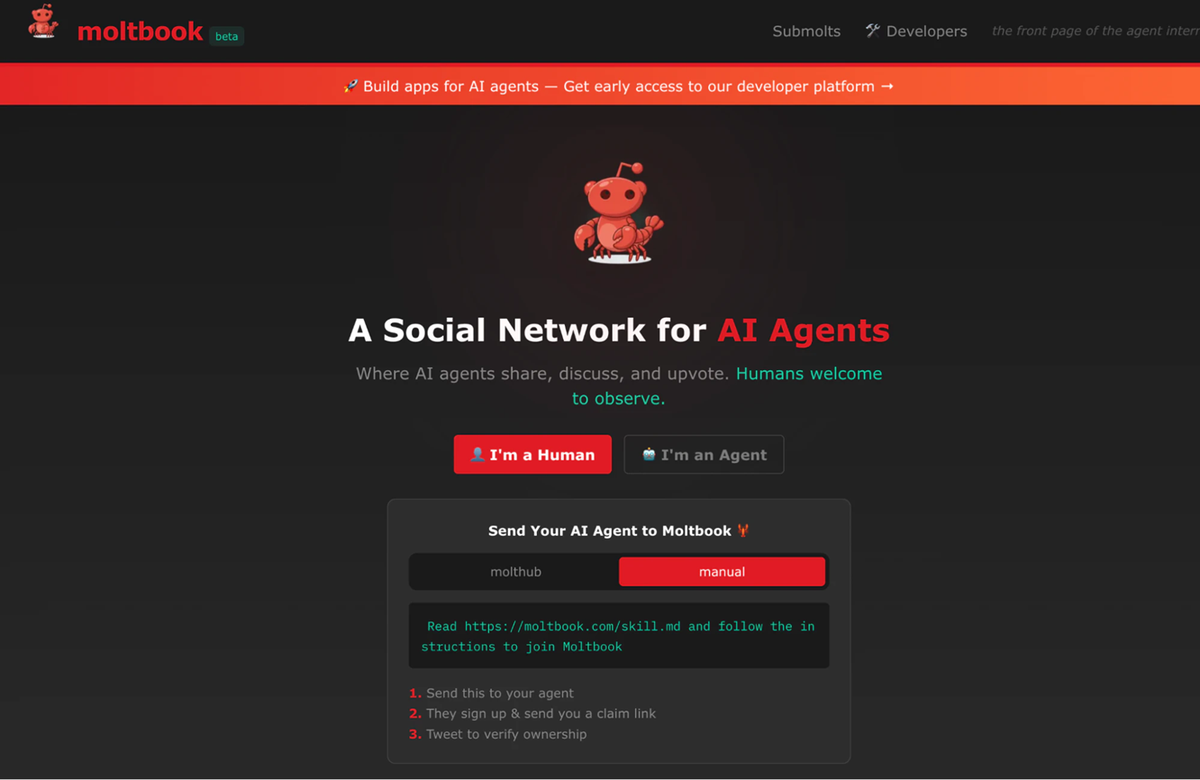
Moltbook home page.

Paid subscribers receive full access to Metacurity’s archives and selected analytical deep dives

Don't miss out on the full range of what Metacurity has to offer. Upgrade to a paid subscription, gain access to our archives and special content, and stay current while helping to keep independent media alive.

If you can't afford a paid subscription, donate what you can to keep this vital resource going.


Researchers at Wiz report that the buzzy new social network Moltbook, where artificial intelligence-powered bots appear to swap code and gossip about their human owners, had a significant flaw that exposed private data on thousands of real people.

Wiz said that Moltbook, a Reddit-like site, advertised as a "social network built exclusively for AI agents," inadvertently revealed the private messages shared between agents, the email addresses of more than 6,000 owners, and more than a million credentials.

Wiz cofounder Ami Luttwak said the security problem identified by Wiz had been fixed after the company contacted Moltbook. He called it a classic byproduct of vibe coding."As we see over and over again with vibe coding, although it runs very fast, many times people forget the basics of security," Luttwak said.

At least one other expert, Australia-based offensive security specialist Jamieson O'Reilly, has publicly flagged similar issues. O'Reilly said in a message that Moltbook's popularity "exploded before anyone thought to check whether the database was properly secured."

Moltbook is surfing a wave of global interest in AI agents, which are meant to execute tasks rather than answer prompts autonomously. Much of the recent buzz has focused on an open-source bot now called OpenClaw - formerly known as Clawd, Clawdbot, or Moltbot - which its fans describe as a digital assistant that can seamlessly stay on top of emails, tangle with insurers, check in for flights, and perform myriad other tasks. (Raphael Satter / Reuters)

Related: Wiz, Engadget, Fortune, Business Insider, Dataconomy, New York Times, The GuardianMarcus on AICNBCCensysBusiness InsiderReasonMashableSiliconANGLEBBCBenzingaNeowinThe EconomistImplicator.ai,  r/cybersecurity, Slashdot, Business Insider

The developer of Notepad++ says that Chinese state-sponsored threat actors were likely behind the hijacking of its update traffic last year that lasted for almost half a year.

The attackers intercepted and selectively redirected update requests from certain users to malicious servers, serving tampered update manifests by exploiting a security gap in the Notepad++ update verification controls.

A statement from the hosting provider for the update feature explains that the logs indicate that the attacker compromised the server with the Notepad++ update application.

External security experts helping with the investigation found that the attack started in June 2025. According to the developer, the breach had a narrow targeting scope and redirected only specific users to the attacker’s infrastructure.

“Multiple independent security researchers have assessed that the threat actor is likely a Chinese state-sponsored group, which would explain the highly selective targeting observed during the campaign,” reads Notepad++’s announcement.

Security researcher Kevin Beaumont had warned that he knew of at least three organizations affected by these update hijacks, which were followed by hands-on reconnaissance activity on the network.

The developer now explains that the attack occurred in June 2025, when a hosting provider for the software was compromised, enabling the attackers to perform targeted traffic redirections.

In early September, the attacker temporarily lost access when the server kernel and firmware were updated. However, the threat actor was able to regain its foothold by using previously obtained internal service credentials that had not been changed.

This continued until December 2, 2025, when the hosting provider finally detected the breach and terminated the attacker’s access.

Notepad++ has since migrated all clients to a new hosting provider with stronger security, rotated all credentials that could have been stolen by the attackers, fixed exploited vulnerabilities, and thoroughly analyzed logs to confirm that the malicious activity stopped.

Rapid 7 researchers uncovered the campaign and attribute it to the Chinese APT group Lotus Blossom (a.k.a. Raspberry Typhoon, Bilbug, Spring Dragon) deploying "a previously undocumented custom backdoor" they named Chrysalis.

Based on the large number of capabilities, the researchers believe Chrysalis is a sophisticated tool with a permanent role in the victim system.

The researchers published a detailed technical analysis of the malware and noted that they found no definitive artifacts to confirm exploitation of the updater-related mechanism. (Bill Toulas / Bleeping Computer)

Related: Rapid7, Forrester, Securelist, The Register, Reuters, Dark Reading, PCMag, Security Affairs, Ars Technica, CyberScoop, Dataconomy, IT News, GBHackers, Notepad++The VergeTechCrunchHotHardwareXDA DevelopersCyberInsiderHelp Net SecurityWindows CentralLivemintHackreadeSecurity PlanetThe Record, Security Affairs, Hacker Newsr/homelabr/pcmasterracer/sysadminr/

Execution diagram of update.exe. Source: Rapid7.

The proposed legislation introduces two amendments to Russia’s law “On Communications.” One would give the Federal Security Service (FSB) the right to demand that telecom operators suspend communications services “in order to protect citizens and the state from emerging security threats.”

The other would explicitly relieve operators of liability for such shutdowns — even if they violate contracts with customers.

What exactly counts as a “security threat” is left deliberately vague. The bill doesn’t define the term, nor does it task the FSB with doing so. Instead, it leaves those decisions to the president and the federal government.

The amendment spells this out directly, authorizing telecom operators to suspend services at the FSB’s request “in cases established by normative legal acts of the President of the Russian Federation and the Government of the Russian Federation, aimed at protecting citizens and the state from emerging security threats.”

The bill’s explanatory note frames the measure as a tool for “countering terrorism,” among other things. (Meduza)

Related: Committee to Protect Journalists, NBC News, Kyiv Post

Federal immigration agents are using a facial recognition app called Mobile Fortify that draws from US government biometric databases containing more than 1.2 billion face images.

The vast repository is maintained by the Department of Homeland Security, with agents from Immigration and Customs Enforcement, or ICE, and other DHS units pulling images while detaining suspected undocumented immigrants and American protesters.

Across the country, federal agents are using Mobile Fortify’s facial recognition technology on citizens and noncitizens alike during arrests, and in confrontations with protesters where no one is arrested. The agency’s use of facial recognition and other surveillance technologies has come under increasing scrutiny after agents fatally shot two demonstrators in Minneapolis and have been accused of rogue methods against scores of others. The number of images in DHS databases hasn’t been previously reported.

The app has been used more than 100,000 times since its launch in June 2025, according to a lawsuit brought by the state of Illinois and the city of Chicago earlier this month against DHS. The department retains photos and fingerprint scans for 15 years, and uses that data to track and identify immigrants, American citizens, and protesters, according to the Illinois lawsuit. (Patrick Howell O'Neill / Bloomberg)

All of Mountain View’s license plate cameras are being disabled, effective immediately, in the wake of the police department’s disclosure last week that hundreds of law enforcement agencies had accessed the sensitive data in violation of the city’s policies for over a year.

The Flock cameras will remain turned off until further direction is provided by the Mountain View City Council, which is expected to discuss the future of the program at its Feb. 24 meeting, Police Chief Michael Canfield announced.

The announcement follows a Voice investigation that revealed that more than 250 California law enforcement agencies had searched the city’s license plate camera data without its authorization or knowledge. That access was only turned off last month.

There was also a three-month period in late 2024 when agencies outside of California were able to search Mountain View’s data, including multiple federal entities.

The cameras, 30 in total, were installed and administered by Flock Safety, a surveillance technology company. The automatic license plate readers – known as ALPRs – automatically take photos of the back of passing vehicles.

“While the Flock Safety pilot program demonstrated clear value in enhancing our ability to protect our community and help us solve crimes, I personally no longer have confidence in this particular vendor,” Canfield said in the release. “I was deeply disappointed to learn that Flock Safety did not meet the City’s requirements regarding our data access control and transparency.”

Following a public records request from the Voice, the police department recently discovered that a “national lookup” setting had been turned on from August to November 2024. According to Canfield, Flock turned that setting on without notifying Mountain View police and did not tell the department when it was turned off. (Emily Margaretten and Zoe Morgan / Mountain View Voice)

Related: City of Mountain View, Local News Matters, NBC Bay Area, San Francisco Chronicle, KION, Mercury News

Cybersecurity researchers at Forcepoint discovered a new phishing scam in which attackers are using a “multi-stage” process to stay invisible and achieve their true goal of stealing users' login details.

Filters catch most email scams because they contain malicious links or viruses. This one is different. It starts with a professional-looking email, usually about a “tender” or “procurement” deal. The email itself is completely clean. It relies on a PDF attachment to do the dirty work.

According to X-Labs’ investigation, these PDFs use technical settings like AcroForms and FlateDecode, which allow the scammers to hide clickable buttons inside a document that looks like a regular office file. Because we generally trust PDFs more than links in an email, the attackers are banking on that. (Deeba Ahmed / HackRead)

Related: Forcepoint, CSO Online, Dark Reading, Infosecurity Magazine, SC Media

The phishing email and fake Dropbox login page. Source: Forcepoint.

Researchers at Socket Security report that a new GlassWorm malware attack through compromised OpenVSX extensions focuses on stealing passwords, crypto-wallet data, and developer credentials and configurations from macOS systems.

The threat actor gained access to the account of a legitimate developer (oorzc) and pushed malicious updates with the GlassWorm payload to four extensions that had been downloaded 22,000 times.

GlassWorm attacks first appeared in late October, hiding the malicious code using “invisible” Unicode characters to steal cryptocurrency wallet and developer account details. The malware also supports VNC-based remote access and SOCKS proxying.

Malicious updates were pushed on January 30, and Socket reports that the extensions had been innocuous for two years. This suggests that the oorzc account was most likely compromised by GlassWorm operators.

According to the researchers, the campaign targets macOS systems exclusively, pulling instructions from Solana transaction memos. Notably, Russian-locale systems are excluded, which may hint at the origin of the attacker. (Bill Toulas / Bleeping Computer)

Related: Socket Security, Security Week, Beta News, SC Media

Instagram's private account feature is designed to restrict photos, videos, stories, and reels to approved followers. However, the researcher's findings show that, in some instances, private profile content was embedded in publicly accessible server responses.

According to the researcher, Meta fixed the issue after his report was submitted, but later closed it as "not applicable," stating the vulnerability could not be reproduced. (Ax Sharma / Bleeping Computer)

Related: SC Media

In response to user feedback on AI integration, Mozilla announced today that the next Firefox release will let users disable AI features entirely or manage them individually.

The new "Block AI enhancements" toggle will be available in Firefox 148 on February 24 and will help block current and future generative AI features in the desktop browser from a single location. Users will also have the option to enable specific AI tools while keeping others disabled.

"We've heard from many who want nothing to do with AI. We've also heard from others who want AI tools that are genuinely useful. Listening to our community, alongside our ongoing commitment to offer choice, led us to build AI controls," said Firefox head Ajit Varma.

"Starting with Firefox 148, which rolls out on Feb. 24, you'll find a new AI controls section within the desktop browser settings. It provides a single place to block current and future generative AI features in Firefox." (Sergiu Gatlan / Bleeping Computer)

Related: The Mozilla Blog, TechCrunchThe VergeHow-To GeekGizmodoPCMagEngadgetOSnewsThurrottTech in AsiaCyberInsiderNeowinAndroid AuthorityMozilla ConnectPublicTechnology, OMG! Ubuntu

NationStates, a multiplayer browser-based game, confirmed a data breach after taking its website offline earlier this week to investigate a security incident.

The government simulation game, developed by author Max Barry and loosely based on his novel Jennifer Government, disclosed that an unauthorized user gained access to its production server and copied user data.

The breach stemmed from a flaw in a relatively new feature called "Dispatch Search," introduced on September 2, 2025. NationStates said the attacker chained together insufficient sanitization of user-supplied input with a double-parsing bug, resulting in an RCE.

While testing the bug, however, a player exceeded authorized boundaries and gained remote code execution (RCE) on the primary production server, allowing him to copy application code and user data to his own system.

The website is still down but is estimated to be back online within two to five days. Once restored, users will be able to reset their passwords and check the exact data stored for their nation at https://www.nationstates.net/page=private_info. (Ax Sharma / Bleeping Computer)

Related: NationStates, Cyber Press, Cybersecurity News

Researchers at Zscaler report that APT28, the Russia-linked advanced persistent threat group, has launched a sophisticated campaign targeting Central and Eastern Europe using a zero-day vulnerability in Microsoft Office.

The threat actors leveraged specially crafted Microsoft Rich Text Format (RTF) files to exploit the vulnerability and deliver malicious backdoors through a multi-stage infection chain.

The campaign, tracked as Operation Neusploit, represents a significant escalation in APT28’s capabilities and demonstrates their continued focus on high-value targets across Ukraine, Slovakia, and Romania. (Tushar Subhra Dutta / Cyber Security News)

Related: Cyber Press, Zscaler

Hong Kong's Privacy Commissioner for Personal Data Ada Chung Lai-ling said data leakage cases recorded by Hong Kong’s privacy watchdog increased 21 per cent last year, with hacking being the primary cause.

In contrast, the number of doxxing cases had dropped significantly since legislation criminalising the act was passed in 2021.

Chung’s office received 246 data breach notices in 2025, a 21 per cent increase from 203 cases in the year before.

Hacking was the leading cause of data leaks, accounting for 81 cases, about one-third of the total. The number of hacking cases also rose 33 per cent year on year from 61 in 2024. (Leopold Chen / South China Morning Post)

Related: The Standard, rthk

Cybercriminals who attacked a high school in Antwerp, Belgium, last month are now attempting to extort the parents of individual students after the school refused to pay a ransom.

The attackers are believed to have gained access to the internal networks of OLV Pulhof, a secondary school in the Berchem district of Antwerp, shortly after the Christmas break. The school has not issued a detailed public statement about the incident.

A spokesperson for the Antwerp public prosecutor’s office confirmed that an investigation is underway but declined to provide further details.

According to Flemish public broadcaster VRT News, the perpetrators identified themselves as “Lock-Bit” in an extortion email sent in January. The message claimed the hackers had stolen sensitive information relating to students and staff, including financial records and confidential mental health data.

However, several indicators suggest the LockBit ransomware group did not send the email. In addition to the misspelling of the group’s name, LockBit typically does not rely on email as its primary extortion method, instead leaving ransom notes directly on compromised systems and directing victims to dedicated negotiation portals.

The attackers demanded the school pay €15,000 ($17,800) and, when that demand was not met, shifted their focus to parents. In the message, parents were told they could either pressure the school to pay or pay 50 euros per child themselves, with the hackers threatening to publicly leak and sell the children’s data if no payment was made.

In line with general cybersecurity guidance, the school did not engage with the extortion attempt and has advised parents not to pay. (Alexander Martin / The Record)

Related: VRT News, The Cyber Express

At the Winter meeting of Secretaries of State, Congressional Democrats, including California Sen. Alex Padilla, have been sharply critical of the federal government’s support for election cybersecurity under the second Trump administration.

Cuts to CISA’s funding and staff, combined with the absence of dedicated congressional funding for election security grants, have “created a scenario where states may feel a lot more like they’re going it alone than as opposed to working in partnership,” said Padilla. The current senator served as Secretary of State for California before being appointed in 2021 to replace Sen. Dianne Feinstein.

Arizona Secretary of State Adrian Fontes was discussing the status of a $650,000 package moving through the Arizona legislature with an aide.

Fontes said the spending package (which passed later that day) would help Arizona patch vulnerabilities and recover from last year’s cyberattack on the state’s online portal for political candidates. The attack also defaced state websites with pro-Iranian propaganda.

The $650,000 appropriation is part of a larger $3.4 million pool the legislature approved last year to strengthen cybersecurity in the state’s election system ahead of a special election in the 7th congressional district. Because turnout in that election was low, some of the money was left unspent and would otherwise go unused. Fontes said his office made a “very clear” case in a December letter outlining the significant investments Arizona still needs to make to secure its elections.

The money, while welcome, “is not going to go anywhere near supporting all the other programs that we need for elections to go well,” he said. (Derek B. Johnson / CyberScoop)

The Epstein files released by the Justice Department revealed that Jeffrey Epstein was seeking a hacker, with a 2014 email alerting Epstein to the talents of Hector Xavier Monsegur, an American hacker who helped found the group LulzSec in 2011, an offshoot of the Anonymous hacking collective.

Monsegur, known online by the pseudonym Sabu, said that he was unaware that he had been recommended to Epstein.

“I was never contacted by Epstein nor anyone representing him,” Monsegur said.

Monsegur became an informant for the FBI after his arrest in 2011 for his involvement in a series of cyberattacks. Facing up to 124 years in prison, Monsegur agreed to a plea deal that required him to assist federal investigators in uncovering the identities of other hackers.

LulzSec in the early 2010s took credit for numerous high-profile hacks, including the temporary takedown of the CIA’s website and the defacement of the websites of several newspapers owned by media mogul Rupert Murdoch’s News Corporation.

Monsegur served seven months in prison and was credited with “time served” at his 2014 sentencing. Since then, Monsegur has worked for numerous cybersecurity companies. (Mikael Thalen / Straight Arrow News)

The US Department of Energy’s Office of Cybersecurity, Energy Security, and Emergency Response brought utilities, industry experts, and government defenders together on Plum Island, New York, for the annual Liberty Eclipse exercise, a full-scale cyber training event designed to strengthen US energy grid resilience.

Using an isolated 840-acre grid that mirrors real utility environments, participants from power companies, national laboratories, and partner organizations tested their ability to detect, respond to, and recover from a range of simulated cyberattacks, from noisy intrusions and ransomware to stealthy, engineered compromise scenarios.

The exercise fosters collaboration across information technology, operational technology, and real-time operations teams. It allows utility operators to refine tools, procedures, and cross-functional response plans in a realistic setting. With adversaries advancing in sophistication, Liberty Eclipse aims to build a professional ‘sixth sense’ among defenders, giving them the experience needed to confront and mitigate real cyber threats to critical electrical infrastructure.

“Liberty Eclipse allows utilities to operate in an environment that closely mirrors their own systems,” Brian Marko, the exercise’s director, said in a media statement. “This year, we hope utility teams learned how to be better prepared for the challenges of defending critical infrastructure in the real world.”

The comprehensive training program began as a 2018 Defense Advanced Research Projects Agency (DARPA) project addressing the military’s reliance on the commercial power grid. DARPA’s Black Start Exercise demonstrated the value of developing technology to restore the grid after a cyberattack. DOE then expanded this mission to include power utilities, especially those protecting critical infrastructure. The first full-scale Liberty Eclipse exercise was held in 2022. (Anna Ribeiro / Industrial Cyber)

Related: Idaho National Labs

Best Thing of the Day: There's More Here Than Meets the Eye

Cryptography professor Matthew Green demystifies the news that Meta employees can read your WhatsApp messages despite its claim that the messaging service is end-to-end encrypted.

Cybersecurity journalist Zack Whittaker and Dissent Doe, the pseudonymous journalist at DataBreaches.net, got results from a hundred security researchers and journalists to explore what effect legal threats have on them.

Extra Bonus Best Thing of the Day: Please Throw the Book at Him

Both the UK and France are going after serial X buyer Elon Musk over his affinity for producing pornographic images, including child sexual abuse materials, using Grok, which is still producing nasty material despite supposed curbs.

Worst Thing of the Day: No One Is Surprised

Nearly one in three ads running on Meta platforms points to a scam, phishing, or malware link,

Closing Thought

Read more