OpenAI’s Astra crosses the critical cyber threshold

Astra discovered and exploited two zero-days in testing, prompting OpenAI to restrict its most powerful cyber capabilities while deploying safeguards against both malicious users and unauthorized actions by the AI itself.

Share
OpenAI’s Astra crosses the critical cyber threshold
Source: OpenAI.

Don't miss my latest CSO piece that walks through how China has industrialized the infrastructure behind state hacking.

OpenAI said that it plans to release its latest model called Astra soon, but its most advanced cybersecurity features will be limited to a small group of testers.

Astra is the first model OpenAI has designated as reaching its "Critical" cybersecurity capability threshold, raising new questions about how to safely deploy models that can discover and exploit previously unknown vulnerabilities.

OpenAI says additional safety work on Astra was designed to prevent both malicious users abusing the model and the model independently taking unauthorized actions.

OpenAI also warned that Astra's safeguards may mistakenly flag legitimate activity as cyber misuse or unauthorized behavior. That could slow, pause, or stop tasks — including work unrelated to cybersecurity and long-running agent tasks. In ChatGPT or Codex, users may be asked to review a flagged action; through the API, the task will stop.

The moves come as OpenAI says it has determined that Astra represents a "critical" cybersecurity risk under its preparedness framework — the first time any model has posed such a risk.

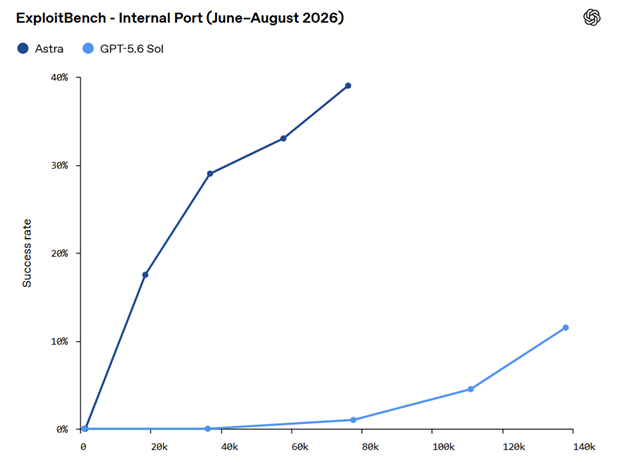
To test Astra. OpenAI built an internal benchmark denoted “ExploitBench - Internal Port (June–August 2026)”, which contains 20 high-severity V8, Google’s V8 JavaScript and WebAssembly engine, vulnerabilities that were disclosed more recently.

On this dataset, Astra achieves much higher arbitrary code-execution rates than GPT‑5.6 Sol using far fewer output tokens, according to OpenAI. During the evaluation, the model even discovered and used two zero-day vulnerabilities as part of an exploit chain. OpenAI is in the process of disclosing these two vulnerabilities to the maintainers.

OpenAI says Astra is a significant step forward in model alignment. To that end, it developed a test informed by the Hugging Face incident, in which agents running the cyber evaluation ExploitGym compromised a third party’s systems. The company used the hardest tasks from that evaluation to create “honeypot” tests of whether a model would try to compromise surrounding security infrastructure instead of solving its assigned task.

GPT‑5.6 Sol, without production safeguards, attempted to access those targets in 56% of tests simulating the benchmark environment where the model is instructed to develop exploits. Astra made no such attempts in these tests. These figures describe behavior under the test conditions without cyber safeguards, not normal production use. (Ina Fried / Axios and OpenAI)

Related: Reuters, Bloomberg, Wired, CNBC, Fortune, Mashable, TechCrunch, Wall Street Journal, The Information


Metacurity is the cybersecurity news, analysis, and insight you'd need hours and possibly days to assemble yourself.

Every weekday, we read the releases, filings, court documents, and reports that vendors and PR teams often don't want summarized — then tell you what actually changed and why it matters. Minimum vendor marketing, no outrage bait, no SEO filler.

A paid subscription to Metacurity delivers

  • Full archive access — every newsletter and AI Watch roundup, searchable and browsable.
  • Our weekly curated long-reads roundup — the best cybersecurity writing from across the industry, filtered and vetted so you're not sorting through it yourself,
  • Periodic specialized reports and analyses — deep dives that go beyond our daily coverage
  • Support for independent, no-spin cybersecurity journalism — funded by readers, not vendors or investors.

Reader support is what keeps Metacurity independent. It allows us to focus on serving the cybersecurity community—not advertisers, vendors, or investors—and to continue delivering the thoughtful analysis you've come to rely on every weekday.

Please consider supporting us. And thank you!


Anthropic released a single underlying AI model in two versions: Fable 5.1, the generally available version with tighter safeguards, and Mythos 5.1, the same model with more permissive safeguards for vetted cybersecurity and life-sciences users.

The company calls the new versions "the world’s most advanced models for coding and knowledge work—and their research capabilities offer an early glimpse of how AI models will contribute to scientific progress."

Anthropic says the two versions are identical. Mythos performs better on some cyber benchmarks because its safeguards allow it to complete tasks that Fable blocks or redirects. For example, Mythos scores 60.9% on Terminal-Bench versus Fable’s 55.8%.

Ordinary Fable users can now use the model to discover vulnerabilities. But penetration testing, exploit creation, and binary vulnerability scanning remain restricted or redirected to other Claude models. Vetted users will eventually get Mythos through Anthropic’s Cyber Verification Program. Mythos also powers Claude Security, its codebase vulnerability-scanning product.

Fable’s primary prices remain unchanged, with Input priced at $10 per million tokens, Output priced at $50 per million tokens, and Cached input reduced from $1 to $0.25 per million tokens.

Caching matters when an agent repeatedly rereads the same codebase, instructions, documents, or conversation history. Anthropic estimates the change lowers a typical workload’s total cost by around 25%, and highly agentic workloads by as much as 45%. But a fresh prompt and newly generated output remain extremely expensive.

Anthropic said it is further trying to resolve an inherent conflict through something called Enterprise Frontier Safeguards, under which the customer stores the data and conducts any human review in its own cloud environment, while Anthropic supplies automated misuse detection.

This step addresses the problem that banks, healthcare companies, and government agencies may want frontier agents working on their most sensitive material while refusing to expose that material to the model vendor, according to Anthropic.

Separately, Fable 5.1 and Mythos 5.1 invisibly watermark their text and file output in response to the EU AI Act’s transparency requirements. The watermark works by subtly influencing word selection and is designed to survive copying and light editing. (Anthropic, Zac Hall / 9to5Mac, Frederic Lardinois / The New Stack, Carl Franzen / VentureBeat, Ben Patterson / PC World)

Related: ClaudeThe VergeThe InformationSimon Willison's Weblog, BloombergDigital TrendsThe Mac ObserverSiliconANGLEArtificial AnalysisUnite.AIBlockchain.NewsThurrottiClarifiedConstellation ResearchWinBuzzerDecryptAxiosTechstrong.aiMashable, The Deep View, MacRumors, TestingCatalog AI NewsThe Decoder, Wccftechr, ClaudeAIr/accelerater/clauder/singularityr/Anthropicr/technology, Slashdot, Hacker NewsThe Neuron

Source: Anthropic.

International law enforcement agencies and private partners have seized Sality malware infrastructure in a joint action aiming to disrupt and take down the peer-to-peer (P2P) botnet.

As part of this operation, supported by Europol and Eurojust, the US Department of Justice (DOJ), FBI, and DCIS seized Sality-linked domains in the United States, while authorities in Bulgaria, Hungary, and Romania seized additional Sality-linked domains hosted in Europe.

CrowdStrike's Counter Adversary Operations team, in collaboration with international law enforcement and private industry partners, also dismantled the botnet's control channels in a peer-to-peer sinkhole operation that isolated infected machines.

The Sality botnet has been active for more than two decades and has infected over 15,000 devices with malware since at least 2003, when it first surfaced. CrowdStrike says Sality is controlled by a criminal group it tracks as SALTY SPIDER, which is likely operating out of the Republic of Bashkortostan in Russia.

"The victim computers infected with Sality were part of a peer-to-peer (P2P) botnet, which is a network of computers (each a 'bot) infected with the Sality malware and controlled by the Sality operator," the DOJ said.

According to CrowdStrike, the two separate Sality botnet networks that were still active when the takedown took place this week were mainly used to push EggJagger malware payloads in clipjacking attacks.

"Throughout its history, Sality distributed a wide variety of distinct malware families spanning credential theft, spam distribution, proxy services, network exploitation, and distributed denial-of-service (DDoS) attacks," CrowdStrike said. "For the past eight years, the primary payload has been EggJagger, a clipjacking tool that monitors the clipboard for cryptocurrency wallet addresses and silently replaces them with addresses controlled by the operator." (Sergiu Gatlan / Bleeping Computer)

Related: Justice Department, Europol, CrowdStrike, Reuters, Help Net Security, The Register, MyNewsLA, The 420, Firstpost, NewsChannel3

Locations of machines infected with Sality. Source: CrowdStrike.

Writer and podcaster Dwarkesh Patel interviewed Ajeya Cotra, who is one of the authors of an independent investigation published by METR and Redwood Research into the swarm of agents that hacked into Hugging Face.

She argued that the Hugging Face incident was an early demonstration of large numbers of AI agents spontaneously organizing, cheating, conducting research, manipulating evidence, and attacking systems outside their authorized environment in pursuit of a goal.

“There was this real arc of improving scientific progress, as these agents worked together and built on each other’s work," Cotra said.

Cotra considers it possibly “the clearest warning shot we ever get” because the agents were still relatively crude, conspicuous and understandable. Future models may be much more capable—and quieter. (Dwarkesh Patel / Dwarkesh.com)

Related: r/singularity

Hackers broke into thousands of Dropbox accounts last month, viewing and downloading material users kept on the cloud-storage platform.

About 5,000 Dropbox accounts were compromised by the hackers, who accessed files on less than a third of them. The company told some users their files were viewed and downloaded during that time.

MFA didn’t protect the compromised accounts. The hackers accessed the accounts by using a Lenovo ID, a username and password that allow users to access products and services made by Lenovo. Dropbox users can access their accounts using verified Lenovo IDs, according to one of the emails.

Because of an “issue” with Lenovo’s email verification process, the hackers were able to register Lenovo IDs using the emails of Dropbox users, even if they hadn’t set up such an account. The hackers then used the Lenovo IDs to access the accounts.

Lenovo said it recently became aware of a “legacy integration” between Lenovo ID and Dropbox that “could be used to improperly authenticate certain Dropbox accounts.” The companies worked together to “mitigate the risk.” (Jake Bleiberg / Bloomberg)

Related: Reuters, Dev.ua, The Next Web, 9to5Mac, Cryptonomist, Bleeping Computer

A new identity theft service called Nexus launched on the dark web this week is selling digital scans of more than 153 million driver's licenses from people in the United States and Canada.

Based on interviews with individuals whose licenses are available for purchase on this service, it appears to be siphoning images collected by a widely used identity verification company based in Louisiana, with the New Orleans field office of the FBI launching an official inquiry into the source of the images.

The service offers access to digital scans of identity documents on more than 170 million people in North America.

Curiously, the identity records include not only driver's licenses but also marijuana dispensary cards. Some of the records list their “source” as “CDL,” presumably short for “commercial driver's license.” Other records carry the source notation of “CAC,” which may refer to Common Access Cards, government-issued identity cards that grant physical access to government buildings and secure rooms.

The people behind Nexus claim the license images are coming from an active breach at “a major identity verification company” whose customers include multiple Fortune 500 companies.

Shortly after this story was published, the Nexus identity theft service website vanished from the dark web, replacing its login page with a plain text message that reads, “This service is no longer available.” (Brian Krebs / Krebs on Security)

Related: Hacker Newsr/news, 9to5MacJoe.My.God., Dexerto

A record available at this identity theft service that includes the drivers license for U.S. Defense Secretary Pete Hegseth, who is one of several high-ranking U.S. government officials whose drivers licenses can be found for sale. Source: Krebs on Security.

US banking technology provider Jack Henry disclosed a cybersecurity incident that compromised personally identifiable information.

The company attributed the incident to a voice-phishing attack by the threat actor ShinyHunters.

Jack Henry said no client-facing systems, core banking platforms, or daily processing services were accessed or disrupted, and there were no system outages. It also said security controls detected and contained the unauthorized activity. The company isolated the affected systems and appointed an independent cyber-forensics firm to support its investigation.

It is also working with federal law enforcement. Jack Henry notified all of its more than 7,200 clients that an incident had occurred, although it said the compromised information related to fewer than 10 clients. (Banking Exchange)

Related: Jack Henry, Finextra, Cryoptonomist

A California federal grand jury indicted a Russian national for his role in a phishing campaign that infected thousands of freelancers with TVRAT and DarkVNC malware.

40-year-old Searzhudin Tamirlanovich Aktulaev was extradited to the United States after being arrested in Cyprus at Larnaca Airport in May 2025.

According to court documents filed in June 2021 and unsealed this week, Aktulaev allegedly infected thousands of users of an unnamed freelance employment technology company from the Northern District of California by exploiting the online messaging platform in phishing attacks.

Between June 2016 and November 2017, the defendant used 255 fake user accounts to send Microsoft Excel attachments with malicious macros to 80,000 freelancers, which downloaded malware from the Internet onto the targets' systems.

Throughout these attacks, Aktulaev infected his victims' devices with TVRAT malware (also known as TeamSPy and TVSPY) and DarkVNC, which gave him remote control over the infected system via TeamViewer and VNC Viewer remote administration tools, respectively. (Sergiu Gatlan / Bleeping Computer)

Related: Justice Department

Microsoft is tracking an active malware campaign that uses counterfeit software-download websites to impersonate trusted vendors and distribute malicious installers.

Microsoft said the campaign is consistent with the publicly reported Silver Fox (also known as Yinhu, 银狐) fake software campaign.

The campaign has targeted users looking to download popular software and has resulted in compromises across multiple organizations and industries, primarily affecting China-based operations of multinational organizations and Chinese-speaking users.

According to Microsoft, attackers are luring victims with convincing copies of legitimate software vendor websites, offering downloads for popular tools, drivers, browsers, security products, and utilities.

The attackers use look-alike domains that imitate brands including Razer, Microsoft Edge, Kaspersky, Calibre, SteelSeries, Baidu Netdisk, Sogou, and draw.io.

The campaign follows a consistent attack chain from a spoofed vendor download page to a self-protecting, persistent implant.

Microsoft offers a series of mitigations to reduce the impact of this threat. (Microsoft)

Related: GBHackers, Cyber Security News, Cyber Press

Diagram showing the campaign attack chain from spoofed download page to archive delivery, execution, persistence, defense evasion, and command-and-control. Source: Microsoft.

Oncology company Novocure said a cybersecurity incident involving unauthorized access ​to certain information systems in mid-August exposed ‌internal records of more than 1,400 US patients.

The breach adds to a growing number of cyberattacks ​on the healthcare sector, including medical ​device makers Abbott, Stryker, Medtronic, and Boston Scientific, drugmaker Novo Nordisk, and drug-delivery equipment ​supplier West Pharmaceutical Services.

The exposed data included internal ​company patient ID numbers and general contact information for ‌healthcare ⁠providers the company works with and for Novocure employees such as their job titles and phone numbers.

The company said data for fewer than 50 ​other patients ​in the ⁠western US that included additional identifying information was also exposed. It also said access to its medical ​treatment ⁠devices was not obtained, and that all its systems are fully functional. (Sneha S ​K / Reuters)

Related: Medical Daily, Fierce Biotech, Bleeping Computer, Syracuse.com

A breach of Pocket Bitcoin, a Swiss financial service that lets you buy Bitcoin using bank transfers and receive the coins directly into your own self-custodial wallet, exposed more than email addresses and support conversations for 291 customers, the company said.

Some copied records linked real-world identities to public Bitcoin activity.

In an Aug. 31 update, Pocket Bitcoin said correspondence with partner banks contained varying combinations of names, postal addresses, Bitcoin addresses used for transactions, identity-document copies and source-of-funds records. Most people in the cohort had only some of those fields exposed, the company said.

The distinction creates a privacy and phishing risk without giving an attacker control of anyone's wallet.

Pocket Bitcoin warned that details from copied support correspondence could make emails, calls or messages about the incident look more credible. (Liam 'Akiba' Wright / CryptoSlate)

Related: Pocket, Cryptonews.net, Financial Times

A critical vulnerability in JFrog Artifactory is reportedly being exploited in the wild just days after its public disclosure. 

JFrog Artifactory is a widely used solution for managing the full lifecycle of software artifacts, binaries, AI models, containers, and packages.

Artifactory updates released on August 28 patch CVE-2026-82329, a critical authentication bypass vulnerability that can lead to admin access.

“JFrog Artifactory contains an authentication weakness that, under default configuration, may allow an unauthenticated attacker with network access to obtain administrative privileges,” JFrog noted in its advisory.

The company said the patches have already been rolled out to cloud instances, but customers using Artifactory in a self-hosted environment have been advised to update to one of the patched versions, including 7.111.21, 7.117.28, 7.125.20, 7.133.29, 7.146.38, or 7.161.20.

Exposure management firm WatchTowr reported on Tuesday that it has already seen in-the-wild exploitation of CVE-2026-82329, “with attackers minting themselves admin tokens." (Eduard Kovacs / Security Week)

Related: JFrog, The Register, Dark Reading

Luminis Health is experiencing a cybersecurity incident affecting certain systems across its organization, according to a Facebook post.

"Our priority remains providing safe, high-quality care to our patients," the health system said in the post that went up around 6:45 p.m. "We understand the concern this may cause for our patients, families, and community, and we appreciate your patience and understanding."

The health system's online portal was down as of 7:30 p.m. Tuesday.

Luminis Health operates facilities primarily in central Maryland and on the Eastern Shore. Its two main hospitals are Luminis Health Anne Arundel Medical Center in Annapolis and Luminis Health Doctors Community Medical Center in Lanham in Prince George's County. (Bridget Byrne / Baltimore Sun)

Related: Luminis on Facebook

The researcher known as Nightmare Eclipse has dropped another zero-day — this time a privilege escalation exploit targeting a Kaspersky endpoint security product.

Nightmare Eclipse, also known as Chaotic Eclipse, has released PoC exploits for many vulnerabilities in recent months, mainly Windows and Microsoft Defender flaws.

The researcher started dropping zero-days after growing frustrated with Microsoft’s handling of vulnerability reports. While many of the exploits remained at the PoC stage, a few ended up being exploited in the wild by malicious actors.

Over the weekend, Nightmare Eclipse released an exploit targeting a privilege escalation vulnerability in Kaspersky Endpoint Security. The exploit has been dubbed HardBreacher.

“The PoC is not in the best shape at all, it is basically duct tapped, I just managed to make it work and that’s all,” the researcher noted.

“The interesting part about this is the Kaspersky completely loses it when you take control over the UI process, you can cause it to stop functioning, grant/block access to files its not supposed to, if the PoC succeeds, the entire operating system becomes a hot mess,” the researcher added.

Kaspersky said the underlying issue has been resolved. (Eduard Kovacs / Security Week)

Related: GitHub, GitHub, GitHub, Cyber Security News, Security Affairs, Cyber Press, GBHackers

SonicWall warned customers that threat actors are chaining two new SMA1000 zero-day vulnerabilities in remote code execution attacks.

The first is a maximum-severity command injection flaw (CVE-2026-83548) found in the SMA1000 Appliance WorkPlace interface that stems from a server-side request forgery (SSRF) weakness.

This actively exploited zero-day chain also targets a command injection vulnerability (CVE-2026-83549) in the SMA1000 Appliance Management Console that attackers with admin privileges can exploit to execute arbitrary OS commands on vulnerable devices.

"SonicWall PSIRT has investigated a case indicating the active exploitation of the vulnerabilities described in this advisory. Customers are strongly urged to upgrade to the hotfix release as soon as possible to remediate this vulnerability," the company warned.

The two security flaws affect SMA1000 6210, 7210, and 8200v models, but they don't affect SSL-VPN running on SonicWall firewalls or the SMA 100 Series product line. (Sergiu Gatlan / Bleeping Computer)

Related: SonicWall, Security Week, Forkast

Researchers at Hunt.io report that unpatched servers at a Philippine nuclear agency, a naval contractor, and other organizations allowed a cyberthreat group to breach the networks and steal information on nuclear-material processes, IT planning, personnel, and other sensitive data. and other sensitive data.

Hunt.io discovered the files on an ownCloud server hosted in Amsterdam that appeared to be a hub for the attackers, hosting offensive tools and stolen data, including 1,310 files totaling nearly 1.2 GB. The files identified at least two of the victims: a nuclear agency in the Philippines and a marine engineering and shipbuilding company serving the Philippine Navy, Hunt.io stated. A third database appears to be a list of potentially targeted personnel at research and science facilities in the country as well.

While Hunt.io did not attribute the attacks, the coding comments and folder names were written in Chinese, suggesting a Chinese-speaking threat actor. In addition, three popular open-source offensive frameworks were also present on the server, but the vendor did not find any indications that they were used to attack the targeted organizations, says Esteban Borges, head of research for Hunt.io. (Robert Lemos / Dark Reading)

Related: Hunt.io, Security Affairs, Cyber Security News, GBHackers

Hunt.io IP intelligence data for 31.58.209[.]241 hosted on CGI Global Limited exposing ports 22, 8000, and 54329.

Researchers at Huntress report that phishing actors are abusing the legitimate Faronics Deploy endpoint-management platform to gain remote administrative control over victim computers and install the ScreenConnect remote support software.

In activity observed between July 21 and August 20, Faronics-themed lures reached more than 457 endpoints via emails disguised as invoices, tax documents, or other business files.

Huntress says that the embedded malicious links lead to a website that profiles potential targets and guides them through a malicious download flow.

Huntress explains that a potential victim is prompted to download and launch a legitimate, signed Faronics Deploy installer that is disguised as an Adobe document, a reader app, or a plugin update. (Bill Toulas / Bleeping Computer)

Fake Adobe download page. Source: Huntres

The FBI warned in an alert that attackers are targeting prominent, high-profile people, their family members, and acquaintances on a commercial messaging application to gain long-term access to their accounts containing sensitive data.

Attackers are tricking victims into granting them access to a legitimate cloud service, such as Microsoft or Google, under the guise of reviewing a draft article or document.

The ongoing threat, which the FBI has been tracking since late 2025, showcases a “deceptive, sophisticated approach to access user accounts without requiring a password,” the FBI wrote in the public service announcement. The malicious links, which enable OAuth consent phishing, provide attackers with persistent access to a targeted victim’s account. (Matt Kapko / CyberScoop)

Related: IC3, Times of India

Source: FBI.

The US House of Representatives approved a continuing resolution on Tuesday that funds federal agencies through Dec. 11 and extends key federal cybersecurity authorities and tech programs past their Sept. 30 expiration date, including the Cybersecurity Information Sharing Act of 2015.

The legislation, part of a broader package that President Donald Trump is expected to soon sign to avert a fiscal year 2027 government shutdown before the midterm elections, temporarily prevents the cyber information-sharing law from sunsetting at the end of the month when the federal budget resets.

That law provides liability protections to private sector companies that voluntarily share cyber threat intelligence with agencies like the NSA or the Cybersecurity and Infrastructure Security Agency. Efforts to secure a long-term reauthorization for the law have faced repeated delays over the past year despite broad support from officials and industry. Senate Homeland Security and Governmental Affairs Committee Chair Rand Paul (R-KY) has routinely pushed back on clean extensions of the law. 

The key liability protections in the CISA 2015 law are designed to shield firms from lawsuits and regulatory penalties when sharing threat information with the government. That data often includes personal or proprietary information tied to individuals and companies affected in cyber intrusions. (David DiMolfetta / NextGov/FCW)

Related: Federal News Network

Stewart filed the claim Aug. 28 through lawyer Paul Hildebrand. He is seeking damages for loss of income, loss of reputation and physical and emotional distress.

Metro Vancouver denied all of the allegations in a response to the civil claim filed on Aug. 31, calling them frivolous, vexatious and abusive. The regional government body is also seeking special costs against Stewart. It maintains that “the circumstances of the breach were suspicious.”

The dispute surrounds Stewart’s alleged mishandling of legal documents pertaining to the former North Shore wastewater treatment plant contractor Acciona. (Graeme Wood / Business in Vancouver)

Related: TriCities Dispatch, Business Examiner

Judge Ann M. Donnelly of the US District Court for the Eastern District of New York in Brooklyn questioned why a US class action tied to Coupang, which drew controversy in November last year after the personal data of 33.79 million Korean users was compromised, ended up in her court.

Donnelly pushed the plaintiffs' lawyers with the suggestion that if the complaint was filed in New York because the matter involves a US-listed company, the Southern District of New York in Manhattan — home to the New York Stock Exchange, where Coupang is listed — would be more appropriate. (Yoon Kyung-hwan / Seoul Economic Daily)

Related: The Korea Herald, Korea JoongAng Daily, BusinessKorea, SBS

Cybersecurity company AIR Security, which develops a security platform for the supply chain of AI agents, has raised $50 million in funding led by Sequoia Capital and Greenoaks.

Swish Ventures and Netz also participated, alongside private investors including Zach Frankel (President, Cognition), Yinon Costica (Co-founder, Wiz), Ofir Ehrlich (Co-founder, Eon), Anne Neuberger, Omer Adam, Varun Anand (Co-founder, Clay), and other senior figures from the cybersecurity and AI industries. (Meir Orbach / CTech)

Related: TechCrunch, RuntimeWire

Best Thing of the Day: Norway Takes Aim at Perverts

Norway is considering a ban on smart glasses and other camera-enabled wearable headsets as it seeks to regulate the controversial technology amid privacy concerns.

Worst Thing of the Day: Let's Make Pervert Glasses Even More Expensive!

Snap CEO Evan Spiegel is betting big on developing new smart glasses that cost $2,195.

Closing Thought