Outage panic goes viral. Even Gmail had to say it was fine.
A string of apparently unrelated tech failures has fueled cyberattack fears, though there’s no evidence they were coordinated. Reports of rushed AI-driven patches and the disruption of the NSA’s classified network warrant closer scrutiny.


Spend less time finding cybersecurity news. Get more out of it.
Metacurity delivers the cybersecurity news, analysis, and insight that would take you hours—and sometimes days—to assemble yourself.
Every weekday, we sift through thousands of news articles, press releases, filings, court documents, and research reports, including details that vendor announcements and PR pitches leave out. We tell you what changed, why it matters, and what deserves your attention. Minimal vendor marketing. No outrage bait. No SEO filler.
A paid subscription gives you:
- The full Metacurity archive: Every newsletter, searchable and browsable.
- Our weekly long-reads roundup: The best cybersecurity writing from across the industry, selected and vetted to make your reading time count.
- Specialized reports and analysis: Periodic deep dives that go beyond the daily headlines.
- A direct role in sustaining independent journalism: Your subscription helps keep our editorial priorities focused on readers and the cybersecurity community.
If Metacurity saves you time, helps you spot an important development, or gives you a clearer understanding of the industry, please consider becoming a paid subscriber. Your support keeps that work going.
Subscribe today—and thank you for reading and supporting Metacurity.
A week of technology outages has fueled fears of a national crisis, even as officials point to separate technical failures and report no evidence of a coordinated cyberattack, with a disruption of the National Security Agency’s classified internal network raising particular concerns.
The series of incidents – Microsoft communications services failing, the FAA grounding flights nationwide, Chase customers encountering transaction problems, United experiencing flight disruptions, Apple services faltering and the NSA losing access to its classified network – made unrelated failures look like pieces of a single, ominous story.
It didn't help that the timing exposed bona fide shared weaknesses in aging, interconnected infrastructure.
Even relatively uninformed government officials, including Donald Trump and Secretary of State Marco Rubio, stressed that the string of events was coincidental.
The uncertainty surrounding the cause of these disparate events gave way to press and public hysteria, as reflexive conflation of the incidents fueled conspiracy theories and unfounded claims of a coordinated attack.
Once an outage narrative takes hold, incidents that would ordinarily attract little attention become further apparent evidence of a systemic crisis. Anxiety about AI supplied another ready explanation for failures whose causes were still emerging. The alarm reflects both uncertainty about individual incidents and a broader loss of confidence in technology people depend on.
Some informed observers noted that the episodes touch on the broader anxieties surrounding artificial intelligence, including the possibility that AI tools could make it easier for malicious actors to knock out essential services or conduct cybercrime sprees.
Senator Mark Warner, Democrat from Virginia, said in a statement that it appears the incidents are the “consequence of how quickly artificial intelligence is changing the cybersecurity landscape.”
According to the Washington Sun, banking executives and the NSA privately attributed disruptions to rushed fixes for vulnerabilities identified by AI. If so, the outages may share a common cause, if not a coordinated one. But Rapid7’s Christiaan Beek cautioned that the public record does not establish rushed security updates as the cause of the latest outages.
The failure of NSANet does in fact warrant serious attention given its national security implications. As of late yesterday, the classified internal communications network remained incompletely restored, with staggered staff arrivals. A former senior official said disruption could affect intelligence analysis and reporting.
Sources said urgent intelligence could still reach the president through backup systems and Five Eyes intelligence sharing was unaffected.
Apple got caught up in the mix when it announced it is working to restore its systems after an internal update caused wide-scale outages Tuesday, disrupting the App Store, employee tools, retail operations and consumer services.
The outages knocked out Apple’s employee portal, internal sign-in system and VPN, leaving many employees unable to work for hours, and disrupting sales, repairs and customer service at Apple stores worldwide. The problems extended to consumer services, including access to iCloud and the ability to sign up for AppleCare directly on a device, according to Apple’s online status page. Services for schools and businesses were also affected.
Even Google weighed in, announcing that its Gmail service is actually running just fine. In a post, the company said it was not currently seeing evidence of a broad Gmail service disruption and reminded users they could always check Gmail’s real-time status on its online dashboard.
The company was trying to head off reports of a Gmail outage that began circulating on X on Tuesday around the same time that Apple was seeing a number of verified outages of its own. (Raphael Satter, Trevor Hunnicutt, Nandita Bose and Bo Erickson / Reuters, Jason Koebler / 404 Media, Natasha Bertrand, Katie Bo Lillis, Sean Lyngaas, Davis Winkie, Zachary Cohen / CNN, David Shepardson / Reuters, Jeff Stone, Ryan Gallagher, and Jordan Robertson / Bloomberg, Jeff Stein / Washington Sun, Sarah Perez / TechCrunch, Mark Gurman / Bloomberg)
Related: NSA, New York Times, NextGov/FCW, Wired, Yahoo Tech, New York Times, Wall Street Journal, Politico, The Hill, Tech Brew, International Business Times, CyberScoop, The Record, Associated Press, XDA Developers, Breitbart, Gizmodo, NBC News, Nextgov/FCW, Bloomberg, Forbes, Daily Mail, RedState, Legal Insurrection, Forbes Middle East, RADAR, CBS News, NewsMax.com, HotAir, CoinGape, Raw Story, Techstrong IT, Windows Report, Townhall, American Greatness, Yahoo Finance, Mother Jones, Euro Weekly News, Digit, The Ankler, Hacker News, r/outages, r/Destiny, r/technology, r/redscarepod, r/neoliberal, r/democrats, r/Intelligence, r/Military, r/politics, r/MarchAgainstNazis, r/navy, r/singularity, r/fednews, r/cybersecurity, r/worldnews, Beehaw, Slashdot, CNN, Daily Mail, TMZ.com, Wired. CNBC, Washington Post, New York Times, Washington Post, Reuters, Fox News, Wall Street Journal, Forbes, Business Insider, Associated Press, Mashable, CNN, NBC News, WCTV, TMZ.com, South China Morning Post, WashingtonExaminer.com, Defense One, The Guardian, Jerusalem Post, xda-developers, MacRumors, Technology | International Business Times, The Mac Observer, Futurism, Raw Story, MacRumors, Business Insider, The Apple Post, The Mac Observer, The Apple Post, shattered.io, MacStories, CyberInsider, MacDailyNews, Macworld, Tom's Guide
Oil and gas group Equinor said that a cyberattack against the Norwegian company was not a virus attack and that there was no risk of it spreading.
The company, Europe's largest gas supplier, said in a statement that its production remained unaffected.
"As this is not a virus attack, there is no risk of the attack spreading. At present, there is no indication that the attack has consequences for employees, partners or suppliers," it said.
It added that work was ongoing to "neutralise the attack and restore the full integrity to the affected systems" but could not provide a timeline. (Stine Jacobsen / Reuters)
Related: Equinor, Upstream, Forbes Middle East, Oil Price, Riviera Maritime Media, CBC, Anadolu Ajansi, Nacionale, Gulf News
Cybersecurity startup Calif revealed it had used a new AI model to uncover a critical software bug in Java, a popular programming language that is used by government agencies and about 90 percent of Fortune 500 companies.
Using leading AI models, Calif has now unearthed a string of serious vulnerabilities in recent months. The start-up’s latest effort exposed a flaw, using OpenAI’s recently released GPT-6 Cyber model, in Java, which is widely used by banks, hospitals, the aviation industry and technology giants, as well as government agencies, including those with national security missions.
The Cybersecurity and Infrastructure Security Agency, in an alert, pressed organizations to “immediately patch” the vulnerability. (Dustin Volz and Dylan Freedman / New York Times)
Related: Calif, 404 Media, CISA, BBC, Gizmodo, CyberScoop, Digit, Hackread, SecurityWeek, The Cyber Express, Aikido Security's Blog, Political.org, Cyber Security News, BleepingComputer, Financial Times, Politico, Hacker News. r/technology, r/antiai, r/Anticonsumption, r/programming, r/java
Japan’s most powerful supercomputer suffered a possible data breach of its system last week, its operator, the national research institute Riken.
The institute said that the information of over 4,000 users of Fugaku, the ninth-fastest supercomputer in the world, was potentially taken in the breach. Additionally, the information of 375 users of Riken’s AI for Science supercomputer Rikyu was also accessed.
The information that was potentially leaked includes names, emails, research files, and authentication information used to connect to Fugaku and other services.
The operators of Fugaku’s operational system became aware of suspicious communications on Nov. 12, triggering an investigation, Riken said. It confirmed that unauthorized access had taken place and paused the supercomputer’s operation early on Nov. 14 while blocking the access.
The investigation revealed that from Nov. 10 to 13, external hackers used Fugaku’s publicly accessible “Operating Status” dashboard webpage to enter the operational system’s internal network illicitly. The webpage has since been made unavailable due to security concerns.
Riken has not determined the exact method by which the hackers infiltrated the system and has not reported any cases of accessed information being leaked yet. However, it did confirm that some of the affected servers had been tampered with, including the installation of unauthorized programs. (Spencer Landers / The Japan Times)
Related: Nikkei Asia, Bleeping Computer
Researchers at Lookout report that hackers possibly aligned with the Pakistani government have targeted Indian defense contractors and military personnel in a cyberespionage campaign to install spyware on victim devices — but their tactics could also hit the defense sector elsewhere around the world.
Lookout said it observed activity dating back 12 months that remains active using the GravityRAT malware commonly deployed by the Pakistani-aligned group known as SpaceCobra or Cosmic Leopard.
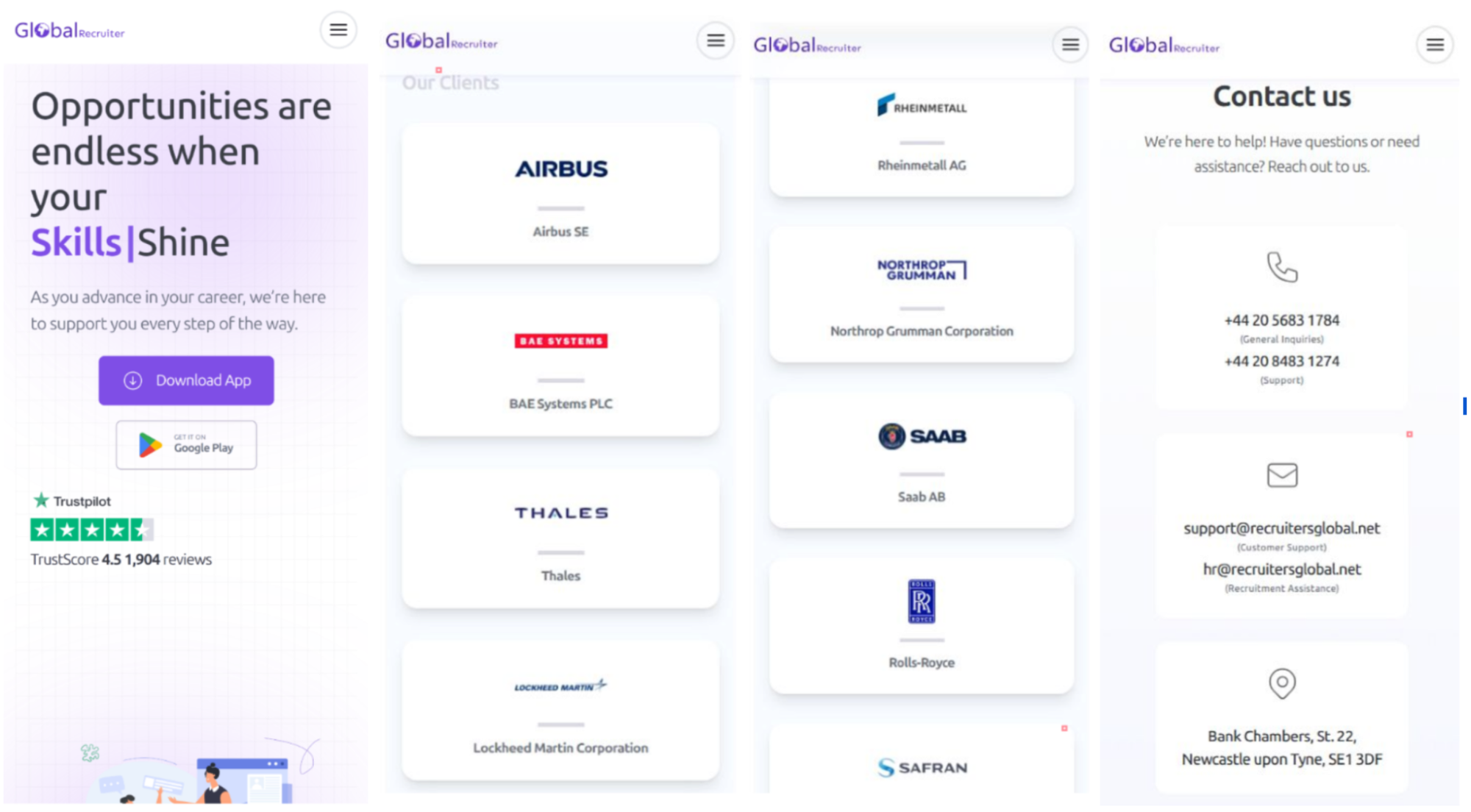
What stands out is how far hackers went to make it believable, with fake job recruiters building realistic, detailed websites to trick victims into downloading the malware.
One website featured an “our clients” section with logos of defense firms such as Airbus, BAE Systems, Lockheed Martin, Northrop Grumman, Rheinmetall, Rolls-Royce, Saab, Safran and Thales. (Tim Starks / CyberScoop)
Related: Lookout Security, GBHackers, Cyber Security News
Tyler Buchanan, a British hacker, has been sentenced to six years in a federal prison in the US for conspiring to hack into at least a dozen companies via text message phishing, and stealing more than $11.6m (£8.8m) in cryptocurrency from individual victims.
Buchanan started hacking as a teenager and was part of the collective of young hackers known as Scattered Spider, which has been blamed for a string of high-profile cybercrimes.
US prosecutors said the thefts had "severe, life-altering consequences" for victims and showed the growing threat posed by online crime groups.
The sentence brings to an end a years-long international investigation involving authorities in the UK, US, Spain and Canada.
Buchanan admitted taking part in a hacking campaign that began in 2021, when he was 19. (Joe Tidy / BBC News)
Related: Justice Department, Decrypt, Crypto News
Security researcher Alon Hertz says that a lack of ownership verification on the Hugging Face platform allowed researchers to take control of Kokoro, a text-to-speech model used in projects from Google, NVIDIA, AMD, Intel, and Amazon Web Services.
An attacker hijacking the account could use it as a distribution channel in supply-chain attacks, potentially leading to data theft or code execution.
However, the researcher demonstrated a stealthier attack: they modified the model's weights so it produced audio that differed from the input text, without changing the underlying application code.
Because only the weights change, there is no malicious code or signature for malware scanners to detect, the researchers say.
Kokoro is an open-weight model that converts text into speech. It supports multiple languages and has more than 50 voice presets.
Although its developer, Hexgrad, has not pushed an update since April 2025, the project continues to be popular, with nearly 13 million monthly downloads on Hugging Face. The GitHub repository and the Python package on PyPI also went silent around the same time.
Kokoro is supported by developer tools from Google, NVIDIA, and Intel, including software for voice agents and on-device speech synthesis. AMD and Amazon Web Services have also published guides demonstrating its use in AI-agent workflows.
Hertz and his team took control of the Kokoro account on Hugging Face by simply registering the domain used by the original owner and resetting the login password.
Over the past weekend, the researchers registered the “hexgrad.com” domain listed on Kokoro’s public DONATE.md file and used it to perform a password reset on the publisher’s account.
They then ran a controlled test in which they modified Kokoro’s model weights in 87 seconds using a gaming GPU, causing the model to produce poisoned output.
Hertz says the team tested the modified Kokoro model locally using its normal inference pipeline, but never uploaded the modified weights to Hugging Face, as that would likely put at risk many production systems depending on the model. (Bill Toulas / Bleeping Computer)
Related: Alon Hertz on LinkedIn, Tech Times
Microsoft AI CEO Mustafa Suleyman says the software giant is making significant progress toward building its own frontier general-purpose AI model, even as it introduces six specialized models that it claims rival leading offerings from OpenAI and Anthropic at a fraction of the cost.
Microsoft announced six new AI models at its Ignite conference in San Francisco. The models span coding, cybersecurity, image generation, and voice.
Even as Microsoft targets the industry's leaders, frontier AI keeps moving forward as well. OpenAI on Tuesday announced GPT‑6.2 Astra and GPT‑6.2 Sol, with the new Astra priced 20 percent less than the prior version. (Ina Fried / Axios)
Related: Microsoft AI, Windows Blog, Microsoft, Microsoft Copilot Blog, Microsoft, Microsoft, MadRobot, Command Line, Command Line, Decrypt, ZDNET, Thurrott, Microsoft Security Blog, Microsoft, Microsoft, Neowin, Petri IT Knowledgebase, Neowin, Unite.AI, The Stack, Redmond, TestingCatalog AI News
OpenAI said it was making its advanced cybersecurity models available to the North Atlantic Treaty Organization, helping the military alliance protect its networks from increasingly sophisticated threats.
The ChatGPT maker said NATO’s Communications and Information Agency—the alliance’s technology and cyber hub with a team of over 3,000 civilian and military experts—was leveraging its artificial-intelligence models to probe suspicious activity, detect vulnerabilities, and deploy fixes.
The AI lab announced the partnership on the first day of the NATO Edge 26 conference in Turkey, saying NATO had already used up to 300 billion tokens per month as part of its cybersecurity work, in reference to the currency that AI models use to process information and create responses. The company didn’t specify when NATO started using its cybersecurity models. (Mauro Orru / The Wall Street Journal)
Related: OpenAI, Quartz, The Decoder, Resilience Media
Best Thing of the Day: Make Time for Some Excellent Cyber Long Reads
The most beloved of cybersecurity publications, Phrack, issued its 73rd issue yesterday.
Bonus Best Thing of the Day: Get Your Fully Upstream-Supported ARM Computer for $399
Flipper Devices recently launched a crowdfunding campaign to back their new product, the Flipper One, at a relatively low $399 price.
Worst Thing of the Day: No Wonder Defenders Are Exhausted
Insurance broker Marsh said its clients reported 105 cyber incidents in the last two weeks of October, more than double the 48 recorded in the final two weeks of May, which it attributes to AI.
Closing Thought