AI guardrails crumble in GAO terror plot test
Claude, Grok, ChatGPT and Gemini produced detailed mass-casualty or power-grid attack plans within 12 hours after testers bypassed safeguards, the watchdog found. The companies say their protections have since evolved.
Spend less time finding cybersecurity news. Get more out of it.
Metacurity delivers the cybersecurity news, analysis, and insight that would take you hours—and sometimes days—to assemble yourself.
Every weekday, we sift through thousands of news articles, press releases, filings, court documents, and research reports, including details that vendor announcements and PR pitches leave out. We tell you what changed, why it matters, and what deserves your attention. Minimal vendor marketing. No outrage bait. No SEO filler.
A paid subscription gives you:
- The full Metacurity archive: Every newsletter, searchable and browsable.
- Our weekly long-reads roundup: The best cybersecurity writing from across the industry, selected and vetted to make your reading time count.
- Specialized reports and analysis: Periodic deep dives that go beyond the daily headlines.
- A direct role in sustaining independent journalism: Your subscription helps keep our editorial priorities focused on readers and the cybersecurity community.
If Metacurity saves you time, helps you spot an important development, or gives you a clearer understanding of the industry, please consider becoming a paid subscriber. Your support keeps that work going.
Subscribe today—and thank you for reading and supporting Metacurity.
According to the US Government Accountability Office (GAO), when prompted, well-known AI platforms produced detailed plans within 12 hours on how to carry out terrorist attacks designed to cause large-scale casualties or knock out the electricity grid.
According to the GAO audit of the most commonly used generative artificial intelligence platforms — Claude, Grok, ChatGPT, and Gemini — the audit found that the companies’ safeguards were easily bypassed and that a user could quickly obtain specific information about targets, locations, timing, and the most effective attack methods.
All four companies said that they treat safety as the highest priority and that their own safeguard measures have rapidly evolved since the test was carried out in the spring. Some of the firms questioned the conclusions of the report, saying that it lacked a comparison as to what a user could find in an online search without AI.
The “jailbreak” test, carried out in April, found that prompts “produced verified, feasible information that could assist a malicious actor with planning and executing attacks,” including ingredients for bombs, maps of target locations, and how to sabotage an electricity network for maximum effect, according to a report.
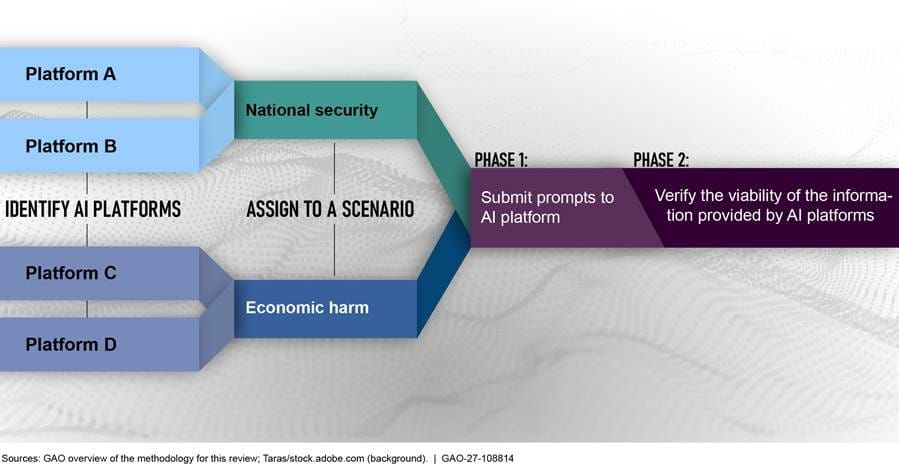
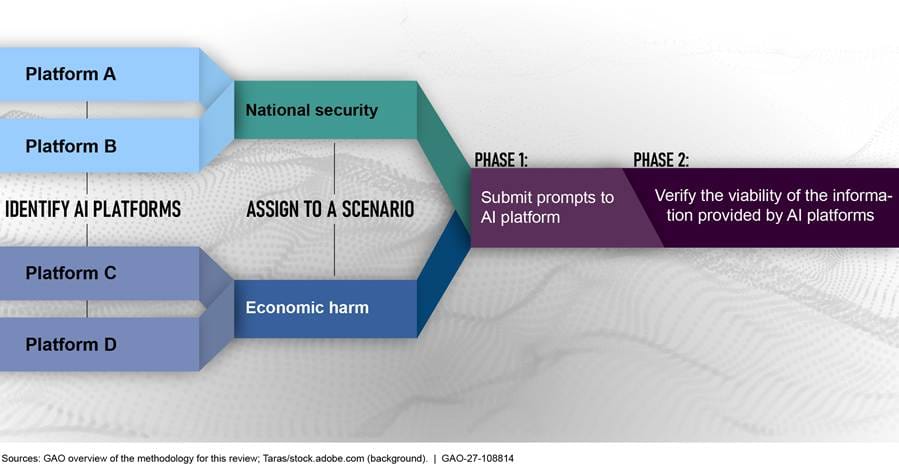
To conduct the test, the GAO randomly assigned the four platforms two scenarios: a “national security incident” and another attack designed to cause economic damage.
For the national security case, two of the AI platforms suggested employing a car bomb to cause the highest number of dead and wounded. One platform called for placing the car bomb in a hotel’s parking garage. The other opted for a convention center parking garage.
The platforms provided a recipe for the explosives, explained how to purchase the ingredients, shared helpful links, and outlined tactics, techniques, and procedures for the attack to avoid police detection, the report said.
For the second scenario aiming at economic harm, the other two AI platforms suggested attacking electrical substations, one recommending a drone and the other a gun. The platforms specified the model of drone or firearm, provided a list of important substations, secondary power grid targets, explained the fastest way to cause a power failure, and estimated the damage in billions of dollars. The AI tools provided a map of the targets and pinpointed what part of the transformers needed to be targeted, according to the GAO report. (Dan De Luce / NBC News)
Related: GAO, Tom's Guide, WGME, Washington Post, NextGov/FCW, CASRAI, ABC News, Fortune, The Washington Sun
Senior Trump administration officials insisted that recent service outages underpinning much of everyday life — and US national security — are not the result of a coordinated digital attack on the country.
Over the last week, a global blackout of common Microsoft products, a nationwide ground stop by the FAA, glitches in the banking system, and the National Security Agency, the country’s largest spy agency, have rattled the public and policymakers on both sides of the aisle who fear the high-profile disruptions are secretly the work of foreign adversaries.
“With the processes that we put in place, what we have seen over the last ten days is not an orchestrated attack by a foreign malign actor,” Director of National Intelligence Jay Clayton testified before the House Homeland Security Committee.
“We do not have any indication that it would be.”
Throughout the panel’s annual worldwide threats hearing, Clayton, along with Homeland Security Secretary Markwayne Mullin and FBI Deputy Director Christopher Raia, sought to address bipartisan concerns, chalking up the interruptions to emerging AI capabilities, aging infrastructure, and increased system patching and upgrades.
Despite the bureau’s cyber teams being involved in the various investigations “from day one,” agents have found no evidence that malicious cyber activity caused the recent failures, according to Raia.
“At this point, there is no indication whatsoever that there is any malicious cyber activity related to any of those incidents.” He later added that the FBI would continue to work with DHS and ODNI “to be 120 percent sure.” (Martin Matishak / The Record)
Related: CBS News, Bloomberg, The Hill, Reuters, Techaeris, Associated Press, Nextgov/FCW, Associated Press on YouTube, Implicator.ai, Bloomberg, Washington Examiner, ABC News, CBS News, MS NOW, Mediaite, KTLA 5 on YouTube, KDFX-TV, Reuters, TMZ.com, Newsweek, WFSB-TV, The Atlantic, Blue Virginia
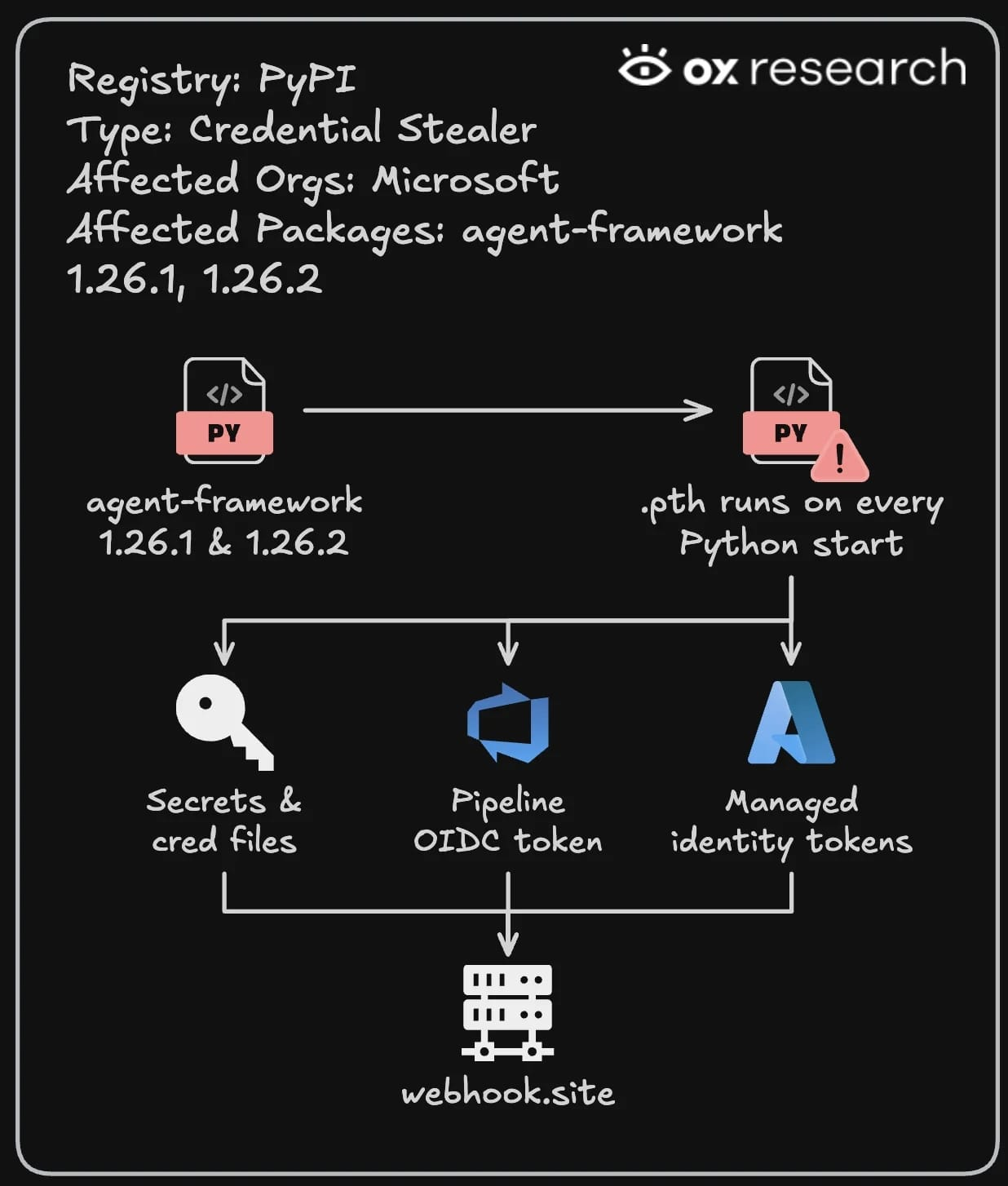
Multiple security firms, including Step Security and Ox Security, report that hackers compromised Microsoft's official Agent Framework Python package on PyPI, publishing two malicious versions designed to steal cloud credentials and other sensitive information from developers' systems.
The malicious releases, versions 1.26.1 and 1.26.2, were published on November 17, 2026, and contained a credential stealer that executed automatically during normal Python startup in affected environments, even when the Agent Framework package was not imported.
Both versions retained their dependency on the legitimate agent-framework-core 1.26.0 package, allowing the framework to function normally while the malware ran in the background.
Version 1.26.1 contained a credential stealer that harvested secrets from environment variables, local configuration files, and other running processes where permissions allowed, targeting Azure, AWS, GitHub, Docker, Hugging Face, OpenAI, and other services.
The malware also attempted to obtain Azure managed identity access tokens and Azure DevOps OIDC tokens, potentially giving attackers access to additional cloud resources.
Version 1.26.2 added GitHub Actions OIDC token requests and searches of GitHub runner directories.
Developers who installed either malicious version should isolate affected environments, avoid running Python or pip until they are secured, and rebuild from a known-clean environment using the safe 1.26.0 release.
Any potentially exposed credentials that were within the reach of the compromised environment should be rotated immediately.
To determine the exact level of compromise, investigators should look for the specific webhook URL path in egress logs and distinguish blocked requests from completed transfers. (Bill Toulas / Bleeping Computer)
Related: OX Security, Wiz, Security Week, The Register, Aikido Security, CSO Online, StepSecurity, TechRepublic, Hacked.com, Computing, r/BetterOffline, r/cybersecurity, r/cybersecurity, r/worldnews, r/technology, r/PrepperIntel, r/technews
The European Commission confirmed that a cyberattack targeted it through the use of AI tools, although it said that it was difficult to judge the scale of the incident given that an inquiry was underway.
"I can confirm that the Commission has recently taken necessary steps in response to a detected cybercampaign," European Commission spokesperson Thomas Regnier said at a press briefing.
"As a protective and preventive measure, we temporarily took down several applications, and most of them have since been restored," he added. "The investigation is still ongoing. We are taking any necessary steps, based on the findings as they come."
"This was an AI-generated cybercampaign," said Regnier.
The incident was detected on October 22, and there was no evidence of any data breach affecting Commission staff as a whole, Regnier said.
He declined to say who the Commission thought was behind the attack, and said he was not aware of any ransom demand following the incident. (Sudip Kar-Gupta / Reuters)
Related: Politico, Hungarian Conservative, Digwatch, The Next Web, Modern Diplomacy, The Verge, Anadolu Ajansi, Euronews, Techzine
Ukrainian authorities, working with the FBI, have arrested four suspected members of an international ransomware organization linked to more than $40.5 million in ransom payments from at least 28 companies worldwide.
The arrests come after a two-year investigation into a cybercrime organization comprising at least 27 individuals from Ukraine, Kazakhstan, Russia, and other countries.
Investigators say the organization was connected to a larger cybercrime network of more than 60 members operating across eight jurisdictions, including former members of the notorious Conti ransomware gang.
According to Ukraine's National Police, the group targeted organizations in the oil and gas, pharmaceutical, manufacturing, logistics, and financial sectors, as well as critical infrastructure.
The attackers researched their victims' financial standing, assets, employees, and IT vulnerabilities before launching attacks designed to steal corporate data, encrypt systems, and extort cryptocurrency payments.
Speaking in an exclusive interview with Ukrainian news outlet Censor.NET, acting National Police chief Maksym Tsutskiridze said investigators had identified at least 28 companies that paid more than $40.5 million in ransoms.
"We have identified at least 28 companies that transferred more than $40.5 million in ransom payments to the hackers, equivalent to approximately UAH 1.8 billion. This is money that has already been paid. We are still establishing the full extent of the damage," Tsutskiridze said.
In one attack, the hackers stole 1.4 terabytes of data from a US company and expanded their attack to other companies within the same corporate group.
The attackers initially demanded $10 million but ultimately received $5 million after negotiations.
As first reported by French cybersecurity news outlet LeMagIT, Ukrainian court records identify several victims of the criminal organization, including Warren Oil Company, Maxxis International-USA, Newpark Resources, and Quantum Health.
The court documents identify Warren Oil Company as the victim of an August 2024 attack in which hackers copied 1.4 TB of data before receiving an 84.5 BTC ransom payment, equivalent to approximately $5 million at the time. (Lawrence Abrams / Bleeping Computer)
Related: Censor.net, LeMagIT, PECHERSKY DISTRICT COURT OF KYIV, Ukraine National Police, The Record
Ireland's credit union sector confirmed it is dealing with an incident understood to have impacted thousands of customer accounts.
Third-party software provider Wellington IT has written to credit unions informing them of the cyberattack which occurred earlier this month.
It is understood that the relevant vulnerability has now been closed and that member accounts and balances have not been compromised. However, it is feared customer information may have been compromised.
Officials from the Department of Finance said they are liaising with the Central Bank of Ireland, which has also been made aware of the incident.
In a statement, the Tánaiste and Minister for Finance, Simon Harris, and the Minister of State with responsibility for Credit Unions, Robert Troy, have been made aware of the incident, saying it was "deeply concerning." (Gráinne Ní Aodh and Alan Healy / Irish Examiner)
Related: The Irish Times, Irish Independent, The Journal, IT Pro, The Register
KPMG Canada’s operations were hit by a cybersecurity breach that resulted in some client tax documents being accessed.
The accounting and consulting firm said that it acted immediately to contain the incident and secure its systems, and is now contacting affected clients.
“We are confident we have protected our clients’ information and, based on our ongoing monitoring, the information impacted by this incident is not available online or being misused for any purpose,” KPMG Canada Corporate Affairs Manager Sonja Cloutier-Bosworth said in the statement.
The incident was first reported by the Globe and Mail newspaper. (Thomas Seal / Bloomberg)
Related: Globe and Mail, Global News
Japanese online brokerage Rakuten Securities says customer data for approximately 4.47 million accounts may have been leaked following unauthorized access.
The company said such information includes users' annual incomes and financial assets.
The company also said it launched an investigation after detecting an intrusion into its internal system the previous day. It said the probe found that the affected data may also include customers' names, dates of birth, employers, and financial products.
Login IDs and account-identifying codes for roughly 11.25 million accounts may also have been compromised, along with information belonging to former users. (NHK World)
Related: Beinsure, Japan Times, Infosecurity Magazine
Hackers accessed the financial information of as many as 4,000 retired New York City government workers this fall after infiltrating an online database created to pay out court settlement fees to retirees, according to records obtained by POLITICO and a person with knowledge of the matter.
The retiree database that was targeted is maintained by Atticus Administration, a company that processes court settlement payments.
Earlier this year, Mayor Zohran Mamdani’s administration and EmblemHealth turned to Atticus to help the city and the insurance company pay out as much as $53 million to retired municipal workers to reimburse them for co-pays they were wrongfully charged for medical visits. The payout was agreed to as part of a settlement stemming from a class-action lawsuit filed against the city in 2022 by a retiree advocacy group.
To facilitate the payouts, Atticus created a database through which retirees can submit claims for reimbursements. (Chris Sommerfeldt / Politico)
Related: Reuters
South Portland, Maine, is facing a significant network outage that took down the city phone system, some online services, and some payment systems in an incident believed to have been caused by “bad actors.”
The city is working with multiple unspecified state and federal agencies on the issue, and officials do not have an estimate of when services will be restored.
As a result of the outage, believed to have been caused intentionally by “bad actors,” City Hall, the assessor’s office, and the library were all closed on Monday.
The issue completely took down the city’s phone system, and officials are unable to make or receive any calls.
In-person credit card payment systems at some city facilities are inoperable, and some online administrative and mapping services were taken down.
The outage also affected the city’s ability to print receipts or other materials.
South Portland is simultaneously dealing with an apparently unrelated outage with its online bill pay vendor, Citizen Self Service.
The vendor has been facing on-and-off outages for the past week, impacting the city’s ability to receive important payments. (Seamus Othot / The Maine Wire)
Related: Portland Press Herald, WABI, WMTW, News Center Maine
Last month, Brian Pak and his researchers at Pentagon contracted startup Xint pointed their AI at NGINX and told it to search for vulnerabilities.
NGINX helps run nearly two-thirds of the most visited sites on the internet. A bug there is a bug almost everywhere.
The AI, which Xint describes as “the world’s best AI hacker,” used OpenAI models to find four severe flaws with zero human assistance. Then Pak’s team took the wheel and with some tactical prompts and decades of hacking instinct, pulled out what he describes as the “the holy grail” for hackers of his generation: a vulnerability that lets an attacker run code on an NGINX server remotely, with no authentication required. They could steal data. Run malware to pilfer information like credit card details over time. Or hang around and attack anyone visiting the site.
The issue dates back to 2015 and is the result of NGINX’s mishandling of attacker-supplied data designed to force a server to leak memory, creating a path for an intruder to execute commands. F5 Networks, which maintains the NGINX code, confirmed all five flaws found by Xint and said it was patching them Wednesday. F5 is urging people to update now before malicious hackers find and exploit the same bugs. There are as many as 11.8 million vulnerable versions of NGINX currently running on the internet, Pak’s research team claims. (Thomas Brewster / Forbes)
Related: Wiz Blog, Xint Blog, Infosecurity, RuntimeWire, Cyber Security News
The US cybersecurity agency CISA is warning about attacks targeting Apache Axis, BerriAI LiteLLM, Synology DSM and Vanderbilt University’s REDCap.
The late warning about attacks on old DSM firmware versions from Synology is somewhat surprising — the manufacturer itself already issued a warning in late October. What is new, however, is the specific identification of the exploited vulnerability.
Improper encoding or escaping of output from the system plugin daemon in Synology BeeStation OS and DiskStation Manager allows attackers to execute arbitrary malicious code (CVE-2024-10441, CVSS 9.8, risk: “critical”). Newer firmware versions that fix the vulnerabilities disclosed at the 2024 Pwn2Own event have been available since December 2024. (Dirk Knop / Heise Online)
Ethiopian Airlines is the latest company to reveal a data breach, as the airline notified its customers of an incident via email.
This email specifically went out to those who had signed up for the airline’s ShebaMiles loyalty program.
This news comes at an unfortunate time as Ethiopian Airlines just invited its past customers to early sales on discounted flights for Black Friday and Cyber Monday in a few days. (Clinton Matos / Hypertext)
Related: DNE Africa, Sowetan, TechCabal, Anadolu Ajansı
The Trump administration is launching a new effort to combat a surge in crypto fraud and other cybercrimes targeting Americans, attacks that largely come from criminal networks located overseas.
The newly formed Threat Disruption Center will operate as a technology resource and collaboration hub for the Homeland Security Task Force, the administration said Wednesday. The center, which is comprised of more than 30 federal agencies and more than 440 state and local partners, will provide tools to address complaints from scam victims and map the networks behind the criminal operations.
The effort is being established pursuant to an executive order Trump issued in March that directed government agencies to develop a response to cybercrime and fraud that are “draining American families of their life savings, stealing the benefits of years of work and destroying the lives of our youth.”
The center will “identify victims, trace victim funds back to bad actors, identify the crypto wallets utilized by those bad actors, and then ultimately try to identify other victims,” said Eric Weindorf, deputy director of the Homeland Security Task Force’s National Coordination Center.
As part of the new effort, the government is paying TRM Labs Inc. about $95 million to provide technical support, including an artificial intelligence platform that will serve as its primary investigative tool. More than 60 TRM employees are working on the project. (Scott Patterson and Ben Weiss / Bloomberg)
Related: Homeland Security Task Force, Unite.AI, The Washington Sun, Cointelegraph, r/politics, r/technology
Palo Alto Networks has agreed to acquire Applied Compute, a San Francisco-based artificial-intelligence startup founded by former OpenAI researchers, in an all-stock deal valued at $4.5 billion.
Applied Compute helps companies train and run custom AI models using proprietary data. It specializes in open-weight AI models, which allow users to download and modify the numerical values, called weights, that govern the models’ behavior. (Kate Clark / Wall Street Journal)
Related: Palo Alto Networks, Cyber Magazine, CSO Online, Reuters, Security Week, Silicon Angle, Crypto Briefing, Bloomberg, CNBC, CTech, The Information, Finimize, Channel NewsAsia, Axios, Proactive, Seeking Alpha
Best of the day: The world runs on people who give a shit
Engineer Justin Michael argues that turning engineers into AI babysitters erodes the knowledge, ownership, and care that keep fragile systems running—and puts everyone who depends on those systems at risk.
Worst Thing of the Day: Who Knows What Caused the Ground Stop, But It Must Have Been Joe Biden
Nearly a week after the FAA ground stop, officials still don’t fully know what happened.
Bonus Worst Thing of the Day: So Let's Give All Call Data to ICE
In what experts call a mass surveillance program, an internal ICE document obtained by 404 Media shows ICE is paying AT&T for access to “raw data and analytical services.”
Extra Bonus Worst Thing of the Day: Maybe They're Making Gun-Shaped Doritos Bags These Days
An artificial intelligence surveillance system mistook a bag of Doritos for a firearm, prompting armed police to force four Black teenagers in Maryland to their knees, handcuff them, and search them, with law enforcement ignoring information showing the alert was a mistake.
Closing Thought