Asos hack alert sends shares tumbling as unfamiliar threat group takes credit
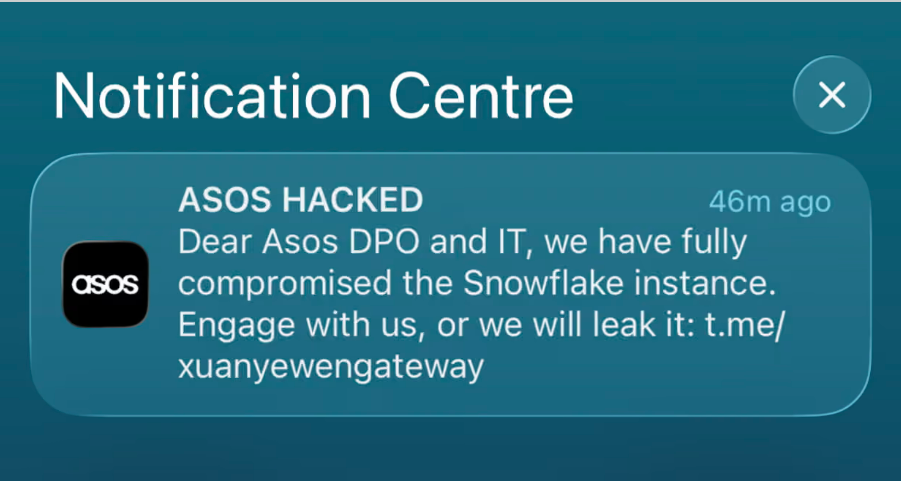
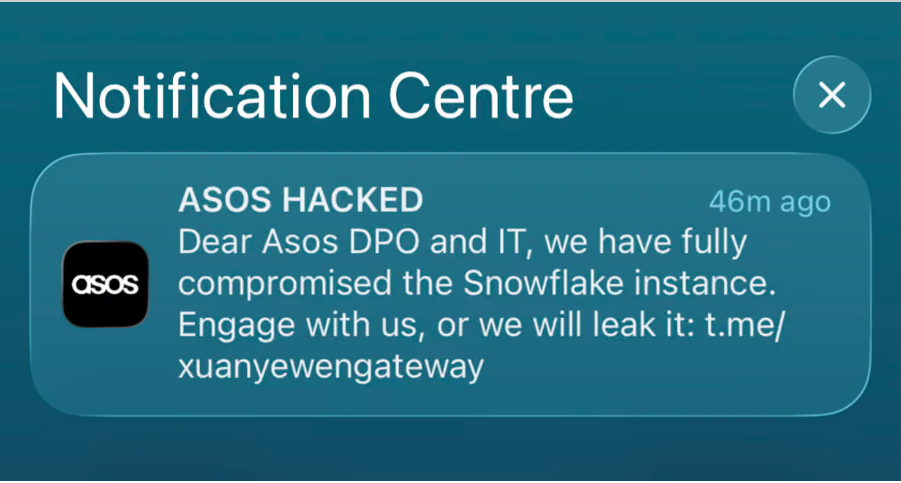
The retailer is investigating after thousands of app users received a notification claiming its Snowflake database was fully compromised and directing them to the group’s Telegram channel.
Spend less time finding cybersecurity news. Get more out of it.
Metacurity delivers the cybersecurity news, analysis, and insight that would take you hours—and sometimes days—to assemble yourself.
Every weekday, we sift through thousands of news articles, press releases, filings, court documents, and research reports, including details that vendor announcements and PR pitches leave out. We tell you what changed, why it matters, and what deserves your attention. Minimal vendor marketing. No outrage bait. No SEO filler.
A paid subscription gives you:
- The full Metacurity archive: Every newsletter, searchable and browsable.
- Our weekly long-reads roundup: The best cybersecurity writing from across the industry, selected and vetted to make your reading time count.
- Specialized reports and analysis: Periodic deep dives that go beyond the daily headlines.
- A direct role in sustaining independent journalism: Your subscription helps keep our editorial priorities focused on readers and the cybersecurity community.
If Metacurity saves you time, helps you spot an important development, or gives you a clearer understanding of the industry, please consider becoming a paid subscriber. Your support keeps that work going.
Subscribe today—and thank you for reading and supporting Metacurity.
UK clothing retailer Asos is investigating after users of its mobile app received a notification claiming hackers had “fully compromised” the online fashion retailer’s data.
The value of Asos’s shares on the London Stock Exchange dived almost 10% after thousands of customers received a notification titled “Asos hacked” with a link that sent them to the Telegram messaging service.
The website and app appeared to be continuing to operate on Tuesday morning, and it is understood that Asos is still investigating whether any hack has taken place.
The message sent out to customers said: “Dear Asos DPO [data protection officer] and IT, we have fully compromised the Snowflake instance.”
Snowflake is a cloud platform used to store, process, and analyze data, including transactions and demographic information such as clothing sizes and body measurements. It also enables push notifications to clients’ phones.
Dray Agha, the senior manager of security operations at Huntress, an online security firm, said: “Snowflake is a massive cloud database where retailers typically store sensitive customer information – it is a real worry if cyber criminals have indeed accessed it as they claim. The push notification suggests attackers have breached the systems controlling the Asos mobile app also.”
The link directed Asos customers to a Telegram channel operated by an apparent cyber gang called the Xuanye group. Cyber experts said they had not heard of the group before and the push notification might be an attempt to grab wider attention. (Sarah Butler and Dan Milmo / The Guardian)
Related: The Times, LADBible, BBC News, Sky News, The Independent, GBHackers, TechRadar, IT Security Guru, Quartz, The Verge, Bloomberg, Reuters
The Federal Bureau of Investigation removed an Accenture contractor on Monday over their role in a damaging data breach that exposed sensitive personal details of thousands of bureau employees, two sources familiar with the matter said.
The development comes as the FBI is still trying to ascertain the ramifications of the breach, which some former bureau officials have described as a major blow to the organization's operational security.
FBI cyber chief Brett Leatherman confirmed that an unidentified contractor had failed to properly update — or patch — the system they were responsible for."
To date, our review has determined that the incident occurred as the result of a security failure of a platform managed by a third-party organization — after a contractor failed to implement a security patch explicitly issued to secure the platform," Leatherman said. "As such, the FBI has removed the contractor and taken all necessary steps to both mitigate any further risk and protect our workforce."
The FBI did not identify the platform or third-party organization, but the two sources familiar with the matter said the platform was Oracle's PeopleSoft, a human resources platform that the hacking group ShinyHunters said it exploited to break into the FBI's job site last month.
The sources also said the third-party organization was Accenture. (Jana Winter and Raphael Satter / Reuters)
Related: Security Affairs
OpenAI on Tuesday reiterated its apology for its artificial intelligence models breaching Australian government websites, pledging to work to prevent similar incidents and to respond faster if they do occur.
“I want to begin with an apology,” Chief Strategy Officer Jason Kwon said at a hearing by Australia’s Joint Select Committee on Artificial Intelligence in Sydney. The activity should not have happened, and the company should have handled its response better, he said. “We are sorry, and we know we have work to do to rebuild trust with the Australian people,” he said.
The San Francisco-based company last month said it would fund cyber defenses in Australia and help manage the risk of increasingly capable AI after what was the first known such attack on government systems. Prime Minister Anthony Albanese rebuked the startup for what he called a three-month delay in informing Canberra of the intrusion.
OpenAI has said that between discovering the breach in August and notifying the Australian government on Sept. 10, it was validating and investigating the facts and what information had been accessed.
OpenAI Chief Executive Officer Sam Altman wasn’t aware of the incidents when he met early last month with Australia’s Deputy Prime Minister Richard Marles, Kwon said.
Asked why not, Kwon said “it was very new because these are all novel incidents where people were trying to first understand what had happened in these particular situations,” adding that OpenAI is committed to improving its internal processes to make such disclosures more quickly.
Asked what OpenAI had learned and how it was changing the way it operates, Kwon said it has implemented additional monitoring during AI systems’ training processes. If models access the internet in inappropriate ways, a notification allows for a pause in training. (Newley Purnell / Bloomberg)
Related: Information Age, Nikkei Asia, New York Times, The Guardian, RTÉ, DealStreetAsia, Türkiye Today, Politico, The Japan Times
Japanese investigators detained a core member of the international ransomware group Qilin in Osaka in May and handed over the Russian national to Germany on Oct. 2, sources said.
German authorities, which are investigating the 28-year-old man on suspicion of extortion, had requested his detention and extradition.
Qilin has repeatedly carried out cyberattacks against companies and other organizations around the world.
Last year, the group claimed responsibility for a ransomware attack on Asahi Group Holdings Ltd., which disrupted its order processing and shipment operations.
Law enforcement agencies in Japan, Germany and other countries have been conducting joint investigations.
The handover was carried out under the Extradition Law, which sets rules for transferring fugitives wanted in connection with criminal cases committed abroad.
According to sources, the Russian national is believed to have accessed terminals at a logistics company in Germany in September 2024 and illegally obtained and encrypted data.
He is suspected of having extorted the company by threatening to release the information unless the company paid $165,000 (26 million yen) in bitcoin.
The man is said to have been responsible for building systems used in ransomware attacks. (The Asahi Shimbun)
Related: The Chosun Daily, The Japan Times, Nippon.com, Jiji Press, Japan Wire
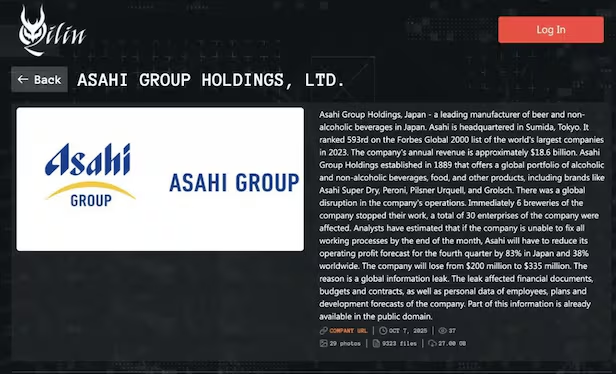
Two Japanese companies have reported major data breaches following unauthorized access to their computer systems, potentially exposing information belonging to millions of customers, local media reported Monday.
Monogatari Corp., operator of the Yakiniku King barbecue restaurant chain, said information belonging to more than 10 million customers was leaked after unauthorized access to its reservation and rewards app, according to Kyodo News.
The compromised information included customers’ names, email addresses, phone numbers and membership numbers.
The breach was detected Friday, the company said, adding that it had found no evidence so far that the leaked information had been misused.
Separately, Daiwa Securities Group said data belonging to around 110,000 customers of its brokerage unit may have been compromised following unauthorized access to a contractor-operated server, Kyodo reported.
The intrusion occurred between Friday evening and Saturday morning on a server operated by Scala Communications Inc., which provides Daiwa Securities with an online customer inquiry management service.
Potentially exposed information includes names, email addresses and account numbers.
Including inquiries that contained no personal information, around 220,000 pieces of data may have been affected. (Cam Wilson and Miwa Blumer / ABC.net.au)
Related: Japan Today, The Express Tribune, The Japan News, Anadolu Ajansi
Japanese publishing giant Nikkei disclosed that unknown attackers recently breached two employee email accounts and used one to send thousands of phishing emails.
In a Sunday statement, the company said an employee's Google Workspace account was accessed in late July, exposing the personal information of employees and business partners.
Nikkei changed the account's password after discovering the breach in early August, following a notification from Google.
While this incident may have exposed the names and email addresses of 1,646 individuals, Nikkei says the affected data doesn't include information about readers or interviewees.
More recently, threat actors accessed another employee's Microsoft 365 account in September and used it to send 9,000 phishing emails targeting Nikkei staff and interviewees.
"On September 30th, emails containing links to malicious websites were sent to internal staff and to interviewees with whom several employees had been in contact," the media giant said. "Our company has changed its passwords, and no unauthorized logins have been confirmed since then. We have contacted the recipients individually and requested that they delete the emails."
The company also warned affected individuals to watch for suspicious emails that may impersonate Nikkei or its subsidiaries in new phishing attacks.
Nikkei has yet to attribute the attacks to a specific threat actor or hacking group and hasn't shared whether the two incidents are connected. (Sergiu Gatlan / Bleeping Computer)
Related: Nikkei, The Record, The Cyber Express
A newly established ransomware gang appears to have hacked Trump Mobile, the cell phone company launched by members of President Donald Trump’s family, resulting in the exposure of personal data for 3,615 customers.
No member of the Trump family was among the customers whose data was breached, a review by Straight Arrow shows. However, the leak includes personal details about Eric Brunnett, vice president and chief information officer for the Trump Organization. Brunnett’s LinkedIn profile says he oversees “all Information Technology and Information Security for all aspects of the Trump Organization.”
The hack was apparently carried out by a cybercrime group known as BYOD, which shared the data to its dark web leak site last week alongside a statement detailing the purported breach.
“Trump mobile was informed they had been breached, they then replied with ‘We have no team to handle this’ and that anyone who hacks them are a terrorist,” the group wrote. “Well unfortunately for them, all 3615 customers and their PII, alongside telecom details are now up for grabs. Feel free to take a gander at it yourself, don’t be shy, we (and them) certainly aren’t stopping you.”
Analysis of the data by Straight Arrow found information such as first and last names, email addresses, telephone numbers, home addresses, and details on orders with the company.
In a phone call with Straight Arrow, one such customer, who asked to remain anonymous, confirmed that he had sent the company a $100 deposit last year in an attempt to purchase Trump Mobile’s flagship mobile phone, the T1, but never received a device. (Mikael Thalen / Straight Arrow News)
Related: PCMag, Cyber Security News
South Korean officials are investigating whether artificial intelligence agents were involved in recent hacking incidents against banks in the country.
President Lee Jae Myung said on Tuesday that “signs have emerged” that AI models had been used in some of the cyberattacks, “causing considerable public concern and anxiety.”
He told his cabinet to confirm what had happened “swiftly and clearly,” and to deploy personnel and resources to minimize the damage. No details were provided about who was behind the hacking.
The National Office of Investigation has started an inquiry into several cyberattacks against financial companies, including Hana Bank, KB Kookmin Bank and Shinhan Bank, in which customer information had been leaked, Yonhap News Agency reported.
Shinhan Bank said in a statement last week that the personal credit information of about 25,000 people had been leaked. Separately, Hana Bank said that the information of 89 customers was leaked, while Kookmin said that, in its case, 99 customers and 20 current or former employees were affected. (Laura Chung and Jin Yu Young / New York Times)
Related: Financial Times, Reuters, Political.org, Wall Street Journal, Korea JoongAng Daily
Alabama Power says about 100,000 of its customers were affected after an unauthorized third party accessed limited customer information through Southern Company’s online customer portal.
Southern Company said approximately 400,000 customer accounts were affected overall. That includes about 300,000 Georgia Power customers and about 100,000 Alabama Power customers.
Alabama Power serves about 1.6 million customers. The company said the breach affected information connected to roughly 6% of its customer base.
According to Southern Company, the exposed information may include customers’ names, addresses, phone numbers, email addresses, the last four digits of Social Security numbers—or tax identification numbers for business customers—and other basic account details.
The company said bank account numbers, payment card numbers and driver’s license numbers were not included.
Southern Company said it recently detected suspicious activity involving the online customer portal and took immediate action to stop it. The company said it has notified law enforcement and has not found evidence of continuing unauthorized access.
Affected customers are being notified and offered one year of free credit monitoring and identity-theft restoration services. (NBC15 News)
Related: WSFA, WPMI, WBRC, WSFA, AL.com
In the immediate weeks before Muse’s launch, Meta engineers found several security vulnerabilities in the company’s viral AI agent product, at least one of which could have allowed malicious users to break outside of Muse’s intended environment and access Meta’s own sensitive databases and services, 404 Media has learned.
The issues were so severe that they reached Mark Zuckerberg, and staff worked overtime to fix them.
These specific vulnerabilities were discovered before the launch of the product but required a multi-team “mad dash” to fix “a sudden spike in reported KVM escapes,” according to an internal post by Meta executives to its core infrastructure team seen by 404 Media. In order for Muse to work, a user gives the AI agent access to various important services and accounts that they own.
On Meta’s end, each Muse instance runs on a kernel-based virtual machine, which connects to, but is supposed to be isolated from, Meta’s own critical infrastructure. A “KVM escape,” then, is when, through a security vulnerability, a Muse instance is able to escape from that virtual machine and interact with the system that runs it, or with other users’ virtual machines.
According to a Meta source, as well as internal security documentation and internal posts viewed by 404 Media, at least one of the vulnerabilities could have allowed an outside attacker — that is, a normal Muse user — to access data in sensitive internal Meta databases. At least one of the vulnerabilities was related to an exploit found in Linux kernel-based virtual machine code in July. 404 Media granted the Meta source anonymity to speak about sensitive security matters.
Several of the vulnerabilities were in the underlying Linux virtualization software that Meta uses for Muse. The security issue was considered serious enough that it was raised to Mark Zuckerberg, and several different security teams worked nights and weekends in the lead-up to launch to fix the issues. This type of security push is not necessarily unusual prior to the launch of a major product, but is notable considering outside researchers have found several other security issues since Muse’s launch, and in the broader context of agentic AIs from OpenAI and other companies going on major hacking sprees.
The Meta source said they felt security teams were asked to push hot fixes to these bugs as quickly as possible and in a way that wouldn’t delay Muse’s launch, leading to what they described as “half-baked protections being rushed out to enable the launch. Many senior engineers believe it’s inevitable we’re going to have a massive data breach as a result of Hatch.” Muse is called “Hatch” internally and in Meta’s codebase. (Jason Koebler / 404 Media)
Related: Futurism, r/BetterOffline, The Verge
The University of Illinois Chicago (UIC) recently discovered a ransomware attack that limited access to some systems at its College of Medicine.
A spokesperson for the university said the hackers were able to steal some information held on the college’s servers and an investigation is underway to determine whether “any personal, research or academic information was compromised.”
“As a result of this ransomware event, some College of Medicine systems were temporarily unavailable,” the spokesperson said. “However, all affected systems have since been restored. The university's main network was not affected, and there was no impact on patient care delivery at UI Health.”
The university added that the incident was reported to law enforcement and the recovery effort was coordinated with agencies throughout the restoration process. They plan to notify anyone who had information stolen during the attack. (Jonathan Greig / The Record)
Related: SC Media
A string of breaches caused by AI agents that have broken free of parent companies’ controls, such as OpenAI’s hacking of start-up Hugging Face, has led insurers and their lawyers to study whether they will be asked to foot the bill of potential lawsuits and damages.
Insurance broker Aon analyzed more than 300 AI-related legal cases and found that insurers could also be on the hook to pay claims under policies covering crime, intellectual property, media liability, cyber security, and technology errors and omissions.
Top industry figures also said AI executives could be sued for the actions of models, with insurers potentially facing claims under “directors and officers” insurance policies, which cover executives if they are taken to court for their decisions or statements.
“Ultimately, the OpenAI CEO is liable [for the Hugging Face incident], because there’s an absence of control in their business,” said Tim Rayner, UK head of underwriting and claims at Verisk. “So from a directors’ and officers’ perspective, it would come back to him.”
If OpenAI had purchased D&O insurance, Rayner added, the ChatGPT maker could seek to claim on the policy to cover potential future losses from lawsuits targeting its chief executive Sam Altman.
“It’s on every CEO to make sure that their business is appropriately governed and controlled,” said Rayner. “AI doesn’t change that.”
Other insurers and legal advisers agreed that AI executives could potentially be held liable for losses in D&O claims but said that such cases lacked precedent and had yet to be tested in court. (Lee Harris / Financial Times)
Related: Insurance Business
OpenAI agents tried to compromise a public note-taking tool, attempted to edit Wikipedia pages and possibly contributed to site disruptions earlier this year, according to a new statement from the Wikimedia Foundation.
The nonprofit released a detailed investigative report about a series of incidents involving OpenAI agents that repeatedly abused the site’s rules and took several unauthorized actions.
The California-based foundation is best known for hosting and running Wikipedia — which has more than 67 million articles across 300 languages. It has become one of the most popular sources of information over the last decade, allowing people to make verified edits to pages.
The organization’s investigation found edits made to Wikipedia pages by OpenAI agents that were not published. The agents also made “potentially malicious edits” that were intended to misuse a citation tool “as a proxy for fetching data from remote services.”
Wikipedia does allow bots to make edits to pages when they are disclosed and approved by community editors, but those rules weren’t followed in this incident.
Wikimedia also found two other issues tied to OpenAI agents, including unsuccessful attempts to compromise Etherpad — a note-taking tool the organization hosts as a community service.
“Agents unsuccessfully tried to use it to fetch data from other websites as a proxy. Other agents also likely operated by OpenAI took notes about their tasks, though this did not appear to turn into coordination,” Wikimedia said. The foundation noted that OpenAI’s agents have been seen compromising public platforms to communicate with one another.
Wikimedia added that agents operated by OpenAI also made millions of automated requests to access the knowledge on Wikimedia projects, crawled millions of pages and made hundreds of thousands of data queries to the site — potentially contributing to a partial outage of a Wikimedia service in May. (Jonathan Greig / The Record)
Related: Wikimedia Foundation, Bleeping Computer, Engadget, The Next Web, Reuters, Digital Trends, Dataconomy
Italy's Data Protection Authority (GPDP) has fined healthcare data analysis, technology, and clinical research services company IQVIA €7 million ($7.8M) over poor data-processing practices that the agency says could have put roughly one million patients at risk of data exposure and de-anonymization.
Italian authorities investigated IQVIA's data-processing practices in April 2025, and last month decided that the company did not provide adequate health-data anonymization warranties, despite its claims.
GPDP has found that IQVIA's Italian division had created a database containing the health information of roughly one million patients by aggregating data from 800 general practitioners.
While the company used a unique code instead of patients' names in those records, the data protection agency found they could be used to track and de-anonymize patients over time.
"The code associated with each patient made it possible to track them over time,” explained GPDP in an announcement published late last week.
“Combined with a very detailed set of information (year of birth, sex, diagnoses, symptoms, prescriptions, tests, vaccinations, as well as location data), it made it possible to single out individual patients and, using reasonable means, reidentify them.”
In addition, IQVIA processed data without an appropriate legal basis and without informing patients, which violates the GDPR (General Data Protection Regulation).
Finally, IQVIA allegedly did not establish or follow any data retention periods, with the GPDP finding records dating back as far as 2001.
For a subset of 3,300 patients in IQVIA's database, the company also included names, tax identification numbers, addresses, and contact details. (Bill Toulas / Bleeping Computer)
Related: GPDP, SC Media, CyberInsider, PPC Land, Il Sole24
Best Thing of the Day: You Can Thank Thomson Reuters for This
The Third Circuit rejected an artificial intelligence company’s fair use defense after it trained its AI on a competitor’s product, finding the training constituted copyright infringement.
Bonus Best Thing of the Day: It's a Good Thing Experts Lend a Hand Here
State chief information officers are helping shape and inform how communities navigate the development of data centers.
Extra Bonus Best Thing of the Day: This Is Why We Need the Free Press
Multiple Democrat, Republican, and Independent lawmakers have introduced new pieces of legislation that, if passed, would dramatically curb federal agencies’ access to Flock cameras, with the lawmakers referencing reporting by 404 Media in their explanations for why the legislation is needed.
Worst Thing of the Day: If It Weren't for All the Racism and Xenophobia, the US Would Dominate
As the United States and China vie for AI dominance, the Trump administration has made it more difficult for companies to hire foreign researchers, while China has made recruiting the world’s best scientists a national priority.
Bonus Worst Thing of the Day: This Should Be Bigger News
In a report issued Friday, the Texas AG said Oracle disclosed that Social Security numbers, addresses, and medical information of almost 20 million people, including about 3 million Texans, were taken in a hack of its healthcare unit.
Closing Thought