Trump’s cyber leadership crisis is becoming a national security liability
The controversy surrounding his CISA nominee and the departure of his national cyber director expose the gap between cybersecurity ambitions and the capacity to deliver.
Thanksgiving publishing break: Metacurity will take a holiday break beginning November 21 and resume publication on November 30.
We’re grateful for this community and the readership and support that keep Metacurity going. Thank you for making our work possible, and we wish our US readers a peaceful and happy Thanksgiving.
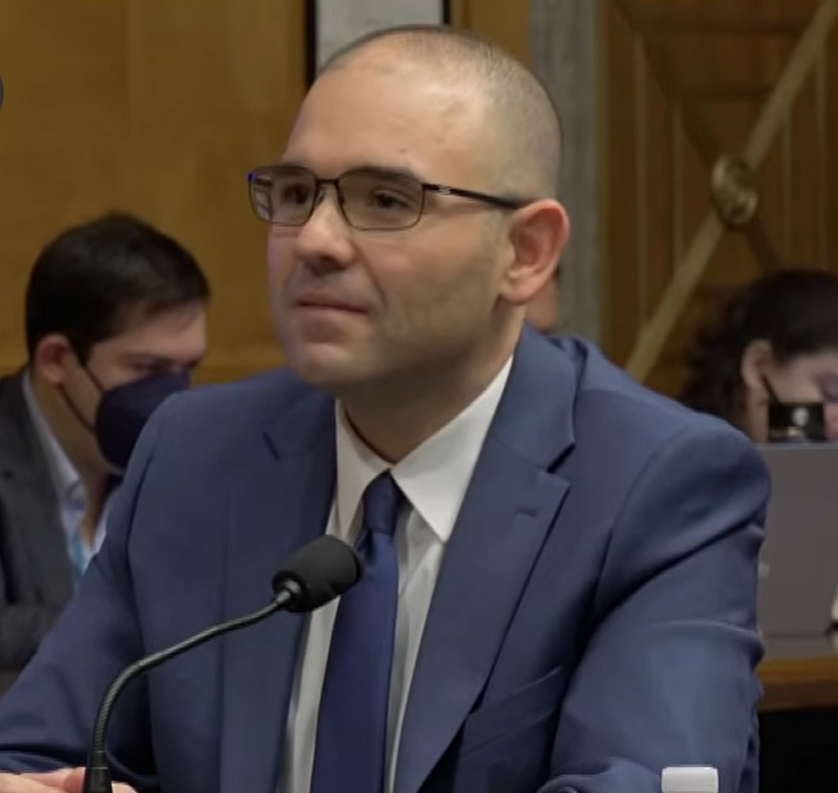
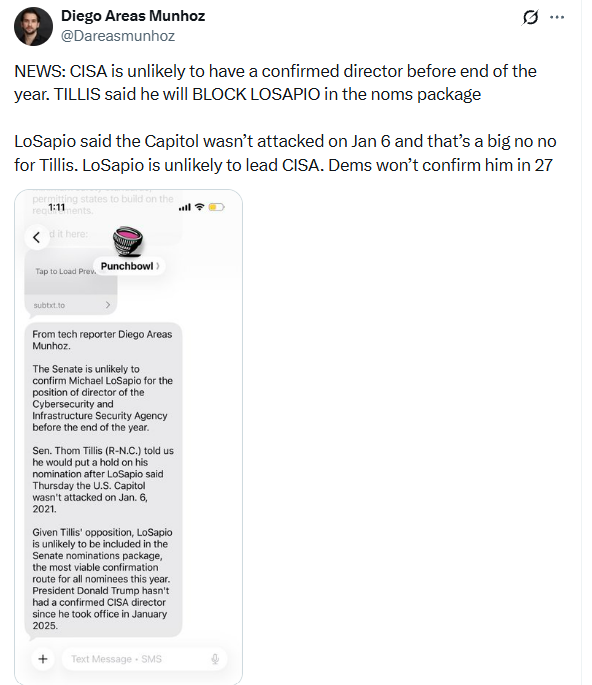
Long-simmering turmoil in the cybersecurity leadership of the Trump administration boiled over into view yesterday when his nominee to lead the Cybersecurity and Infrastructure Security Agency (CISA), Michael LoSapio, all but destroyed his chances to get the job by denying the January 6 attack on the US Capitol, while the White House pushed out National Cyber Director Sean Cairncross in favor of Pentagon Chief Information Officer Kirsten A. Davies.
As the string of unrelated outages that created fear and panic last week demonstrates, cybersecurity leadership is crucial to guiding the US through an era of crumbling digital infrastructure and AI-driven workload burdens, one that demands continuity, institutional expertise, and leaders willing to report unwelcome facts.
Trump's seemingly poor personnel choices when it comes to top cyber leadership raise serious questions about whether his administration can sustain all three.
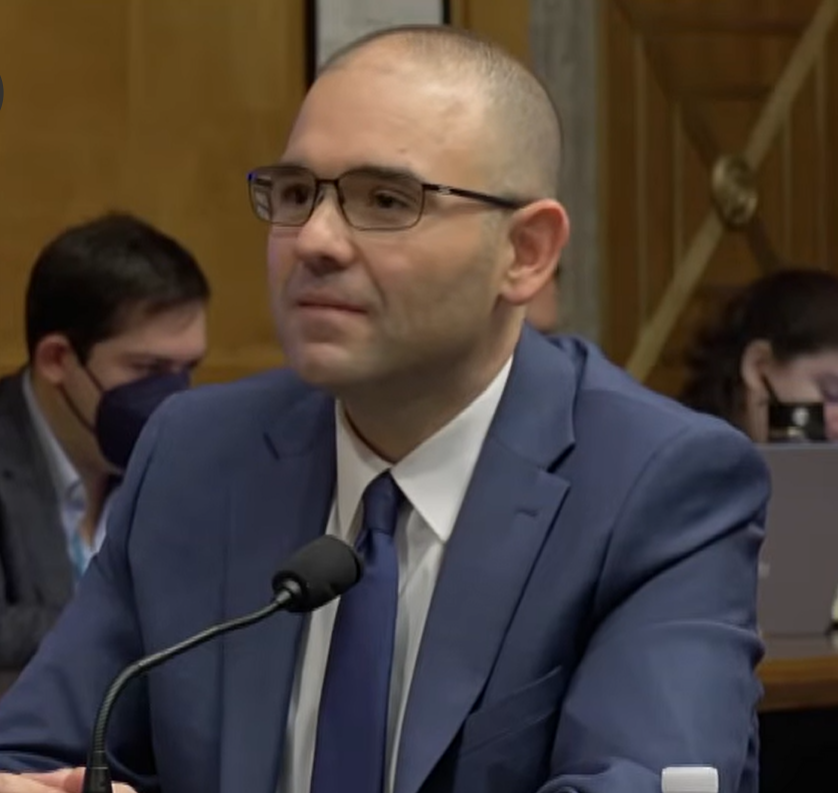
LoSapio, who is currently Palantir’s chief information security officer, made his inflammatory remarks during his confirmation hearing before the Senate Homeland Security Committee, where Democrats also pressed him on whether he would seek to reverse staffing and budget cuts at the government’s main civilian cyberdefense agency.
“No, I don’t believe it was an attack,” LoSapio told Sen. Richard Blumenthal (D-CT) after initially saying he did not know whether the violent January 6 insurrection at the Capitol constituted an "attack." When Blumenthal asked again whether the Capitol had been attacked, LoSapio answered no. LoSapio, who would oversee CISA’s election security mission if confirmed, also refused to say whether Joe Biden won the 2020 presidential election.
While LoSapio's opinion may play well with Donald Trump and his MAGA base, it outraged lawmakers who control his confirmation process. Sens. Ron Wyden (D-OR) and Thom Tillis (R-NC) separately said they plan to place holds on his confirmation, adding a significant bipartisan obstacle to filling a leadership vacancy. Congress is in a lame-duck session, and if LoSapio isn’t confirmed by January, his nomination goes to an incoming Democratic majority, which ensures he won't get confirmed.
CISA has lost roughly a third of its workforce over the past two years, scaled back assistance to state and local offices, and gone nearly two years without a Senate-confirmed director after former nominee Sean Plankey languished in a form of confirmation purgatory before ultimately withdrawing his name from consideration.
While Cairncross had experience in Republican politics and national security, he lacked a technical or cyber background. His office nevertheless helped lead key administration decisions on AI security and the protection of critical infrastructure.
Axios reports Trump's Chief of Staff Stephen Miller pushed Cairncross out over insufficient cyber credentials, although two sources described the departure as amicable. The real questions are why the administration selected him, what he accomplished, and what his replacement is supposed to fix.
The turmoil in leadership at the Office of the National Cyber Director follows a period of staff turnover. Cairncross’s policy chief and senior adviser Thomas Lind joined OpenAI in October. Other senior staff members departed after the administration released its AI executive order, including an adviser involved in early policy negotiations.
As the chaos in Trump's cyber leadership circles deepens, the risks for the security of the nation's power grids, telecommunications networks, hospitals, and other critical infrastructure on which civilian life and military readiness depend keep rising.
Meanwhile, nation-state and criminal threat group adversaries, already poised to exploit the confusion created by the string of outages, have gained only more strategic cyber advantages, with the turmoil leaving the US government less equipped to distinguish routine failures from hostile activity and to respond decisively when an attack comes. (David DiMolfetta / NextGov/FCW, Alex Isenstadt, Maria Curi, Marc Caputo / Axios, David DiMolfetta / NextGov/FCW, Greg Otto / CyberScoop)
Related: CyberScoop, Talking Points Memo, Mother Jones, New York Times, TechCrunch, NBC News, The Guardian, Reuters, Politico, The Hill, Wall Street Journal, Mother Jones, MS NOW, Washington Examiner, Connecticut Centinal, The Independent, Associated Press, Politico, Newsweek, The Record, The Information, CyberScoop, Bloomberg Law, NBC News, New York Post, The Hill, The Gateway Pundit, Nextgov/FCW, The Daily Wire, The Washington Sun, Daily Mail, r/wallstreetbetsr, r/politics
JPMorgan Chase, the largest US lender, said that third parties who provide services to the firm were the target of a cyberattack.
"Based on our investigation so far, we believe the attackers accessed certain marketing data held by those vendors, which may include some customer names and email addresses," a JPMorgan spokesperson said, adding that the company would be contacting the affected customers directly.
"There is no connection to service disruption of some customers experienced earlier this week," the spokesperson added. Earlier this week, the bank experienced problems processing transactions due to a software bug which also affected other banks and caused some disruptions.
A cyber extortion group called "n0n" claimed on November 16 to have obtained cardmember engagement records that included "hundreds of thousands of campaign interactions for tens of thousands of distinct cardmember email addresses," according to a screenshot of the message captured by cybercrime research platform eCrime.ch.
The data includes what appears to be 124 bank employee email addresses and more than 16,000 customer email addresses, some with phone numbers and postal codes, according to a Reuters review. Reuters could not independently verify the authenticity of the data.
A Visa spokesperson said the company is aware of the claims and that they are "associated with an incident involving a third-party service provider in Asia Pacific. Visa’s systems were not involved and were not impacted. No payment data such as card numbers were affected."
A Mastercard spokesperson said the company was recently informed of an incident "at a third-party provider that resulted in the exposure of a limited amount of email addresses — non-payment information — from a small subset of cardholders enrolled in a specific benefit program. There is no impact to the Mastercard payment network or the ability for people to use their cards."
The Visa data posted by the group appears to be primarily focused on Asian-Pacific markets, including Hong Kong, Taiwan, Korea, Japan, the Philippines, Singapore, Malaysia, Australia, Macau, and others, according to a Reuters review. Across several spreadsheets, the data includes thousands of purported customer email addresses, phone numbers, and Visa marketing campaign data. Reuters has not verified the authenticity of the data.
The Mastercard data posted by n0n includes marketing data related to customers in North America, the Middle East and Africa, and a small number of Mastercard employee email addresses. (Nupur Anand and A.J. Vicens / Reuters)
Related: Mashable, TechRadar, Fast Company, The Hill, SQ Magazine, Cyber Security News, AppleInsider, Mashable, Politico Cybersecurity, Washington Post, ABC News, Decrypt, The Independent, PYMNTS, Business Insider, Databreaches.net, UPI, Quartz, Newsweek
The UK government has been forced to admit that it issued a secret order to Apple to allow it access to encrypted customer data, a court has ruled, setting the stage for a public showdown between the Home Office and the Big Tech company over privacy and security.
The Investigatory Powers Tribunal, an independent judicial body, on Thursday rejected the Home Office’s bid to keep secret its attempt to force the iPhone maker to create what critics call a “backdoor” into its systems, bypassing the encryption system that protects user data.
The Home Office has “not established that it would be damaging to national security” to reveal that Apple had received a “technical capability notice” (TCN), the tribunal said. The ruling means that, unlike most of the cases that come before the IPT, “much” of Apple and the non-profits’ legal challenge can now take place in open court.
The UK government has consistently refused to comment on the Apple case since news of the TCN first broke in February 2025, but broke that silence with a statement on Thursday.
The Home Office confirmed the existence of the TCN and said it “simply” required that Apple “maintain the ability” to help the police and intelligence agencies bring criminals to justice, as the law demands.
“These powers are subject to strict safeguards and the government never has access to a company’s communications systems or data,” the Home Office said. “Decisions affecting the safety of the British public must be made by democratically elected governments and independent judges, not in the boardrooms of technology companies.”
Legal campaigners at Privacy International — which, alongside fellow UK non-profit Liberty, had also lodged a complaint against the secret orders at the IPT — called the court’s decision a “big win for accountability, transparency and online security." (Tim Bradshaw / Financial Times)
Related: TechCrunch, The Investigatory Powers Tribunal, MacAnorak, Courts and Tribunals Judiciary, 9to5Mac, Bloomberg Law, Washington Examiner, Liberty, MacTech.com, iThinkDifferent, iDrop News, AppleInsider, Reuters, Telegraph, iPhone in Canada, Seeking Alpha, MacRumors, Reclaim The Net, City A.M., iClarified
US prosecutors charged a Russian national with acting as a foreign agent who allegedly sought information covertly about workers at Palantir Technologies Inc. over Ukraine’s wartime use of the company’s software.
Russia allegedly recruited and directed Igor D’iu to stalk workers at a Silicon Valley technology and defense company, using physical surveillance, electronic tracking devices and phony identification documents to gain knowledge, the Justice Department said Wednesday.
The department didn’t identify the US firm in announcing the charges. A person familiar with the matter who asked not to be named because of its sensitivity identified it as Palantir, which is based in Florida and has a major office in Palo Alto, California.
“The allegations in this case describe a state-sponsored operation to target and harass employees of an American technology and defense company because that company assists Ukraine in its war with Russia,” San Francisco US Attorney Craig H. Missakian said in a statement Wednesday.
Court filings didn’t identify a lawyer for D’iu, who was arrested Oct. 30 and remains in federal custody. He made an initial appearance in court on Nov. 2 and was indicted on Tuesday on charges of conspiring to act as an agent of a foreign government, acting as an agent of a foreign government without notifying the attorney general, interstate stalking, and fraud related to his ID documents.
In the indictment unveiled on Wednesday, D’iu was accused of traveling covertly to the US as part of a broader scheme to conduct surveillance and gather information about the firm, identified as “Company 1” and its workers. D’iu told authorities he was recruited on the Telegram messaging platform to work in the US.
Another person familiar with the matter said there was no breach of information at Palantir. (David Voreacos, Chris Strohm, and Jen Judson / Bloomberg)
Related: Justice Department, Reuters, The Guardian, NBC News, Los Angeles Times, BBC, LAMag, CNN, Ars Technica, San Francisco Chronicle, Kyiv Post, IBTimes.co.uk : Technology, The Register - Security
The personal details of about 265,000 Oyster photocard customers have been accessed in a cyber breach, Transport for London (TfL) has said.
Names, email addresses, home addresses, phone numbers, dates of birth, and security questions and answers were compromised after "suspicious activity" was detected on the photocard website on Monday.
TfL said it took the photocard system offline to limit access and had notified the Information Commissioner's Office (ICO).
It said no photos, passwords, bank or payment card details or journey information were compromised, and affected customers had been contacted.
Shashi Verma, TfL's director of technology strategy and revenue, said: "The protection of personal information is a priority for us, and I apologise to our customers affected by this incident."
He said about 265,000 photocard customers may have had their account details compromised as part of the incident, which he said had been "contained".
No photos, passwords, bank or payment card details, customer journey information, or names and dates of birth of any children with a Zip Oyster card have been compromised, he said. (Jess Warren / BBC News)
Related: Tfl, IT Pro, Cyber Insider, Bleeping Computer, Help Net Security, Sky News, Infosecurity Magazine, The Register, Silicon UK, The Standard
A behind-the-scenes cyber-security operation has taken place to secure tens of thousands of fridges and freezers at major UK supermarkets, warehouses, restaurants, petrol stations and stadiums from hackers, the BBC has learned.
Recent waves of cyber-attacks in Europe have seen tonnes of food spoiled at hundreds of stores, causing millions of pounds of damage.
France has blamed Iran for one of the waves of attacks that impacted its supermarkets, a claim Tehran denies.
It was thought the UK had largely escaped such hacks, as the British refrigeration industry relies on different devices, but there was, in fact, a potential vulnerability the sector has been rushing to fix.
In late October, security researchers discovered a major flaw that, if found by hackers, could have led to even worse damage to the UK.
Since then, researchers, IT teams and the National Cyber Security Centre have been working around the clock to warn dozens of companies.
The security threat was discovered by staff at refrigeration consultants Omega Solutions; it was then verified and expanded upon by experts at Pen Test Partners, who helped raise the alarm.
The National Cyber Security Centre (NCSC), the Department for Environment, Food & Rural Affairs (Defra) and Food Standards Agency (FSA) were then involved in the campaign to plug the security holes.
They held industry conference calls and tasked teams to contact firms at risk. (Joe Tidy / BBC News)
Related: Anadolu Ajansi, Telegraph
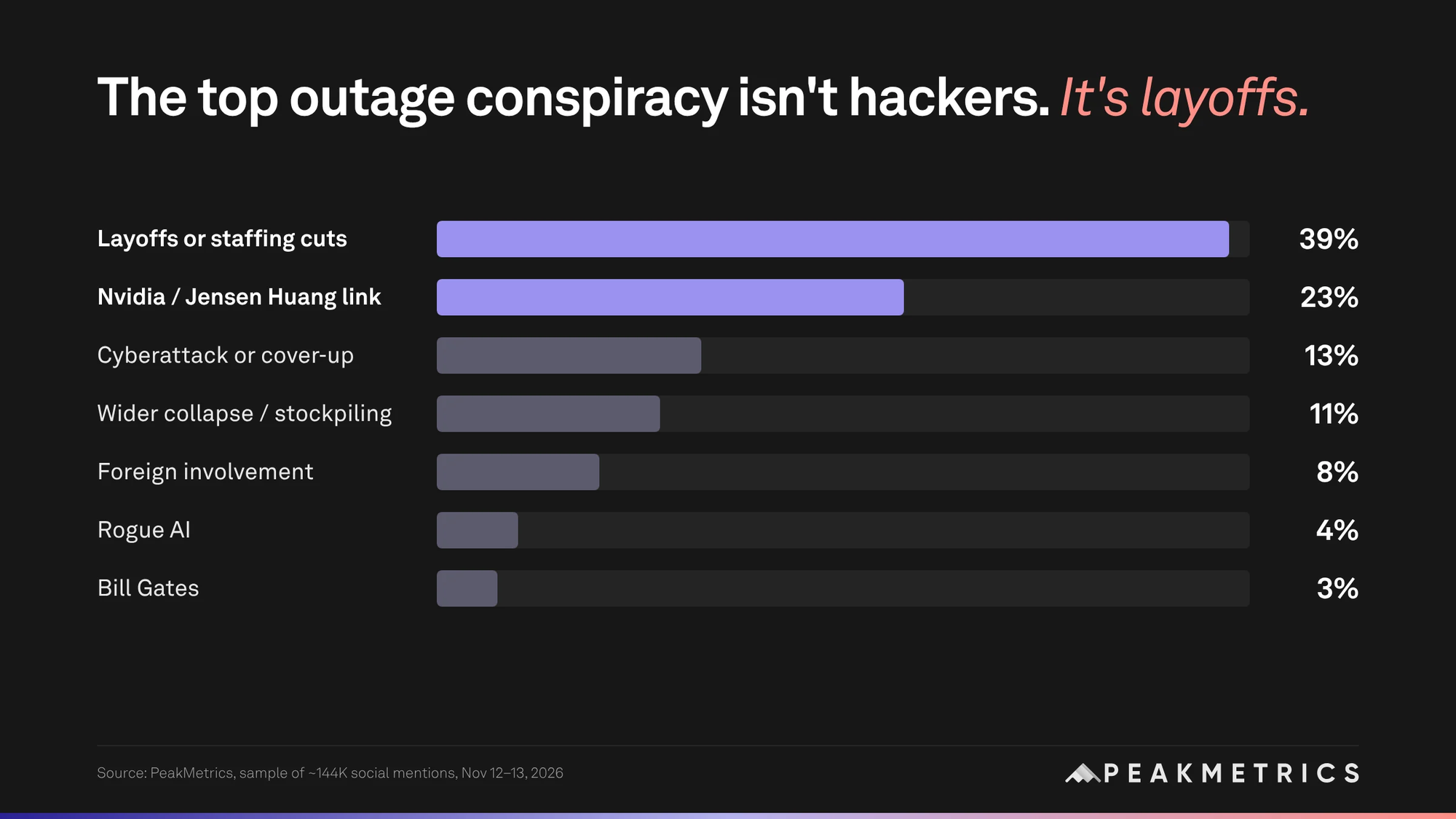
Suspected bots accounted for roughly 30% of posts promoting conspiracy theories about several recent tech outages, according to data from social media monitoring firm PeakMetrics.
During Microsoft's outage, bots accounted for 26% of conspiratorial posts.
Bots accounted for 34% of conspiracy-related posts during Friday's Workday outage, compared with 27% of other posts.
Likely bot accounts also made up 31% of conspiracy-related posts about Bank of America's outage and 28% of posts linking Chase's outage to other disruptions.
PeakMetrics analyzed social media discussions surrounding six recent outages and classified accounts that were likely to be bots and conspiracy-related posts.
Jessica Pratt, a spokesperson for PeakMetrics, told Axios that most of the bot activity is aimed at "gaming the platforms' algorithms" and that it sees some foreign influence within that — although the company could not detail precisely how many of the bots are tied to foreign state media and governments.
PeakMetrics also observed a "small number of foreign state media and state-aligned accounts in the conversation," Pratt added. (Sam Sabin / Axios)
Related: Peak Metrics, National Review
The US government was warned four years ago that security weaknesses in national telecommunications networks had created a “perilous” situation and left the country vulnerable to foreign spies, but it fought to keep a report detailing those concerns secret and didn’t address its findings, according to interviews and documents reviewed by Bloomberg News.
A June 2022 report commissioned by the US Cybersecurity and Infrastructure Security Agency concluded that US telecommunications networks contained “major structural vulnerabilities” that had created national security risks. “The fact that US national networks can be readily compromised from anywhere in the world is not yet widely understood,” states the report.
The report, which was disclosed as part of a lawsuit and reviewed by Bloomberg, was produced more than two years before revelations that a suspected Chinese hacking group known as Salt Typhoon had breached at least nine major U.S. telecommunications and broadband providers, including Verizon, AT&T and Lumen Technologies. The intruders targeted the phones of top politicians – including then presidential candidate Donald Trump – in what US officials described as one of the worst cyber espionage cases in recent history.
The Salt Typhoon hackers used an obscure telecom protocol called SS7, or Signaling System 7, which was one of the vulnerabilities identified in the report, for some early reconnaissance efforts, said a former US official familiar with the breaches. But they didn’t exploit it to gain access to US telecommunications networks, according to the person and a second former official familiar with the matter. Both spoke on the condition that they not be identified because of the sensitivity of the matter.
CISA withheld the report from public release for four years and resisted congressional pressure to publish it. Still, Senator Ron Wyden, a Democrat from Oregon whose office was briefed on the report’s findings in 2023 and pushed for its release, said it advocated an overhaul that could have helped shore up US networks.
“Had this report been made public when it was first written in 2022, Congress would have had ample time to require mandatory cybersecurity standards for phone companies, in time to prevent the Salt Typhoon hacks,” Wyden said in a statement last year. In a statement to Bloomberg this week, he said, “It is totally inexcusable that CISA stonewalled releasing this report for four years, while adversaries were spying on Americans.” (Ryan Gallagher / Bloomberg)
Cybersecurity startup StepSecurity raised $20 million in a Series A funding round.
Elephant led the round, with participation from Runtime Ventures, Inner Loop Capital, and SaaS Ventures. (Chris Metinko / Axios)
Related: FinSMEs
Best Thing of the Day: More of This, Please
France's CNIL imposed a fine of 5 million euros on a company due to insufficient measures taken to ensure the security of its customers' data and an excessive data retention period.
Bonus Best Thing of the Day: Signal Blocks AI Snoopers From Private Messages
Signal is rolling out screenshot restrictions on iOS 27 and Android to stop built-in AI assistants such as Apple's Siri AI and Google's Gemini Intelligence from reading private messages on screen.
Worst Thing of the Day: Fear That Trump Will Spy on Lawmakers
Senator Ron Wyden (D-OR) is urging Congress to secure lawmakers’ phone calls, emails, and video meetings from the executive branch as Donald Trump threatens criminal investigations targeting members who conduct overly aggressive oversight of his administration.
Bonus Worth Thing of the Day: Just Burn Grok Down to the Ground Already
Elon Musk's SpaceXSI has filed its defense against a British lawmaker's lawsuit over fake images of her created using the Grok AI platform, arguing that obviously fictitious, AI-generated content cannot breach someone's right to privacy.
Closing Thought